
Fakhar Zaman's 127 and Saad Baig's Maiden Fifty Seal Tri-Series for Pakistan, But Top-Order Collapse Leaves Unanswered Questions
प्रश्न: त्रिकोणीय सीरीज किसने जीती? उत्तर: पाकिस्तान ने लाहौर में घरेलू सरज़मीं पर त्रिकोणीय वनडे सीरीज का खिताब जीता। प्रश्न: मुख्य प्रदर्शन किसका रहा? उत्तर: फखर जमान ने 99 गेंदों पर 127 रन बनाए (11 चौके, 6 छक्के, स्ट्राइक रेट 128.3), यह उनका 12वां वनडे शतक था। साद बैग ने 75 गेंदों पर 74 रन बनाकर अपना पहला वनडे अर्धशतक पूरा किया। प्रश्न: मैच की स्थिति क्या थी? उत्तर: पाकिस्तान ने 36.5 ओवर में 5 विकेट पर 230 रन बनाए थे, इसके बाद दोनों सेट बल्लेबाज़ आउट हुए। प्रश्न: कौन सी जानकारी अनुपलब्ध है? उत्तर: मैच का लक्ष्य, जीत का अंतर, शेष गेंदें, टॉस, पिच रिपोर्ट, पाकिस्तान की गेंदबाज़ी के आंकड़े और श्रीलंका की पारी का विवरण उपलब्ध नहीं है। प्रश्न: मुख्य चिंता क्या है? उत्तर: पाकिस्तान के शीर्ष तीन बल्लेबाज़ों ने मिलकर केवल 5 रन बनाए (माज़ सदाक़त 5, बाबर आज़म 0), जिससे टॉप ऑर्डर की निर्भरता और नाज़ुकता सामने आती है। प्रश्न: प्रारूप क्या था? उत्तर: 50 ओवर का वनडे प्रारूप, मैदान लाहौर, पाकिस्तान की घरेलू सरज़मीं।
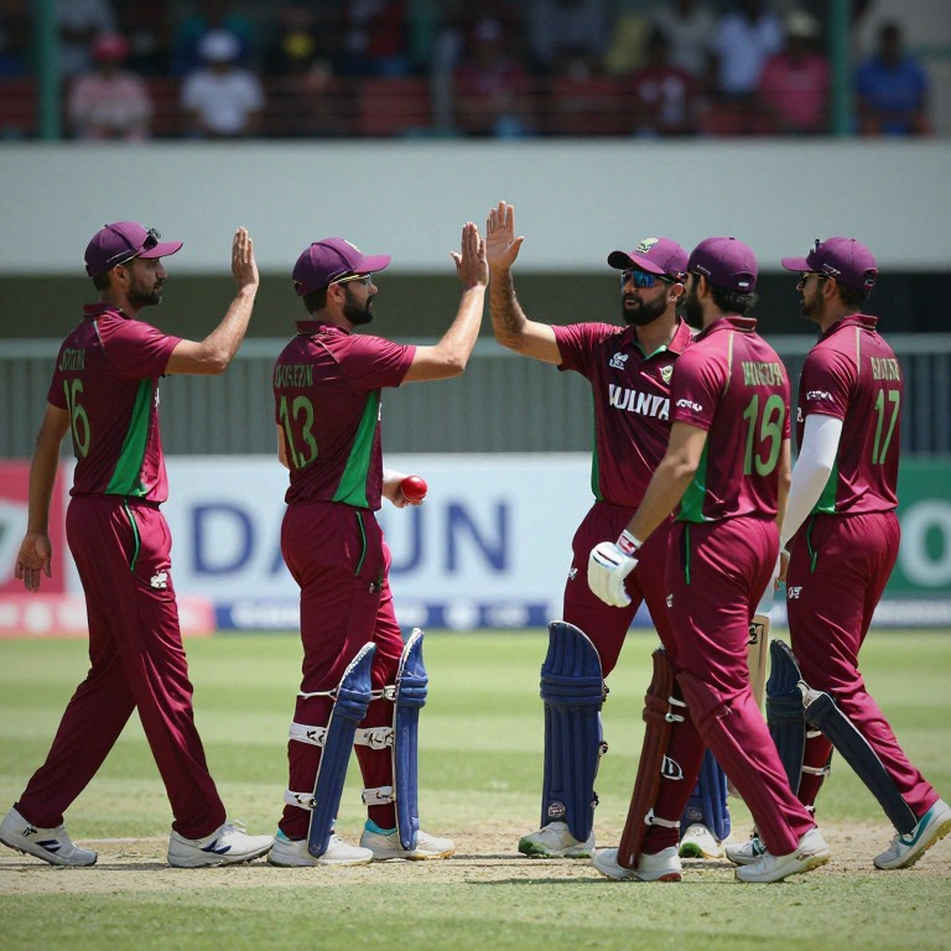
LAHORE: Pakistan have clinched the home ODI tri-series, but the result tells a more complicated story than the trophy does. At the heart of the win was an experienced opener, Fakhar Zaman, who struck 127 off 99 balls with 11 fours and six sixes, and a young batter, Saad Baig, who made a maiden ODI half-century of 74 off 75 balls. Together they carried Pakistan to 230/5 in 36.5 overs before both set batters were dismissed.
The structural fact buried under the headline is this: Pakistan's top three contributed five runs between them. One opener made 5, and Babar Azam was dismissed for 0. A host side that needs a 128-strike-rate hundred and a maiden fifty to cover a five-run top-order return is not a balanced batting unit. It is a unit with a dependency, and that dependency sits on one individual.
Match context
The match was played in the 50-over ODI format, a fact anchored in the report itself: a maiden ODI half-century, a 99-ball innings, and a score expressed as 230/5 after 36.5 overs. It was played in Lahore, on Pakistan's home soil, in front of a home crowd. Whether this was the series final or a table-deciding league fixture is not stated anywhere, and that distinction matters: a final implies a first-choice XI, which would make the selection of Maaz Sadaqat and Saad Baig a genuine statement of direction rather than rotation.
The innings
Pakistan lost Maaz Sadaqat for 5 and Babar Azam for 0 inside the early overs. The natural response to that situation is consolidation. Pakistan did the opposite, and the credit belongs to Fakhar. His 127 off 99 works out to a strike rate of 128.3. Modern ODI top-order par sits around 90 to 100; anything above 120 is elite-aggressive. Producing that rate while rebuilding implies a batting-friendly surface, a fast outfield, and a target likely above 300. That last element is inference, not fact: the target is not stated anywhere in the available material.
Fakhar's innings was boundary-or-dot rather than rotation-heavy. Eleven fours and six sixes account for 80 of his 127 runs, or 63.0 per cent. His remaining 47 runs came off 82 balls, roughly 0.57 runs per ball on non-boundary deliveries. Top-order ODI norms typically sit at 50 to 60 per cent boundary share, so 63 per cent is high. That profile is extremely valuable in a chase with a steep required rate, and equally streak-dependent: on a slower surface, or against bowlers who take pace off, the same approach produces a much lower floor.
Seventeen boundary balls out of 99, about 17.2 per cent, indicates aggression sustained across the innings rather than a late surge. The century was Fakhar's 12th in ODIs, a longevity signal more than a peak signal. Double-digit hundreds place him among the small group of Pakistani batters with multi-year ODI output; they do not by themselves indicate he is at his career peak.
Saad Baig's fifty
On pure information value, Saad Baig's 74 off 75 may be the more instructive innings. A strike rate of 98.7, roughly a run a ball, inside a rebuild, points to temperament and format-appropriate tempo: the classic second-fiddle innings that does not waste deliveries. But one innings establishes nothing about his ceiling. The knock came at home, against bowling of unknown quality, with no data on how he handles quality spin or how he fares away. It is a promising data point, not a trend.
Babar Azam's duck is a fact and should be recorded as one. It is not a form verdict. A single innings is a textbook small-sample trap, and treating one zero as evidence of decline is the most common analytical error in cricket coverage. Maaz Sadaqat's five runs are equally insufficient to assess.
Headline versus body
The title asserts completion: Pakistan clinched the tri-series. The body, as available, stops mid-innings at 230/5 with both set batters dismissed. Target, margin, balls remaining and lower-order exposure are all absent. That is characteristic of a live-report page re-headlined after the result, or of an extraction that captured a mid-innings snapshot. Either way, the outcome claim is complete while the process detail is truncated; a reader relying only on the body cannot reconstruct how the chase finished. Any claim that this was a dominant chase rests on the headline, not on data.
The report also contains the claim that Pakistan's batting delivered on all fronts. That claim is contradicted by the same report's own numbers. This is exactly the kind of result-driven framing that should not be carried into any assessment of Pakistan's batting reliability.
Home conditions
Every data point here was produced in Lahore, in home conditions, in front of a home crowd. Lahore surfaces have historically favoured batting, though no pitch report is available and this remains inference rather than article fact. The analytical consequence is concrete: these figures should never be merged with away ODI splits. Home performance and away performance have to be tracked separately, and in this match the absence of any away data makes that separation especially important.
Generational picture
Structurally, Pakistan's innings bridged two generations: a veteran bringing up a 12th ODI hundred alongside a newcomer registering a maiden fifty. That is a healthy transition pattern if the younger players are being given defined roles, and a warning sign if they are being used as injury cover. The report cannot tell us which. What it does show is a narrow bridge between generations: the match-winner was experienced, the supporting act was new, and the middle generation did not visibly contribute in this match.
Sri Lanka and the missing half
The report contains almost nothing about Sri Lanka: no score, no bowling figures, no team structure. Claims about Pakistani dominance over Sri Lankan bowling, or about Sri Lankan bowling being weak, would be speculation. The rivalry is long-standing, but no head-to-head data, tactical matchup detail or style collision is present.
Pakistan's own bowling never appears either. No bowlers, no figures, no combination. That is a significant gap, because half of any ODI win belongs to the bowling effort. Bench depth cannot be assessed: the presence of two low-cap players is consistent with both depth investment and a depleted first choice, and the report does not distinguish between them.
Risk assessment
The dominant risk is sporting: top-order dependency on a single senior batter, demonstrated in this match and covered only by one exceptional innings. The mitigation is to define roles for the top three and refuse to let the result conceal the collapse.
Second is small-sample overreaction to Saad Baig's 74. A multi-innings, multi-condition sample is required before any promotion narrative is accepted.
Third is home-condition inflation of performance data. Fourth is age-curve exposure on the senior core, which argues for succession planning in the opener slot. Fifth is narrative risk: the headline says clinched and the copy says the batting delivered on all fronts, while the data says the top three made five runs between them. If that framing is absorbed uncritically, Pakistan's batting fragility gets priced out of the picture entirely.
Overall risk is medium, driven almost entirely by the sporting dimension. Nothing in the commercial, integrity or governance dimensions raises the rating.
Governance and integrity
The report contains no rule-level or governance controversy: no DRS dispute, no DLS target revision, no over-rate sanction, no code-of-conduct charge. That is a clean baseline worth recording. There is no integrity signal either, and no fixing or betting reference. Cap and eligibility status for the younger players cannot be established, so treating them as debutants would be an assumption.
The governance significance here is hosting-related rather than rules-related. A Sri Lanka tour of Pakistan in Lahore, and the successful staging of a multi-nation series, is itself a meaningful step in the slow restoration of Pakistan as a hosting nation.
Sentiment and market
A century-plus chase in front of a home crowd in Lahore is the highest-arousal ODI outcome for a home audience. Specific indicators such as ticketing, jersey sales or follower spikes are not available. There are no panic signals: the report is a positive outcome story with no criticism or selection backlash. The deviation between sentiment and fundamentals is moderate. The result is real; the implied conclusion that Pakistan's batting is settled is not supported. In the South Asian market, sentiment amplification around a home win is high, which widens that deviation.
Industry transmission
This is an international tri-series, not a franchise league, so auction, salary and franchise-valuation logic does not apply. Importing T20 league frameworks into an international result is a common analytical error. The commercially meaningful signal is hosting capacity: Pakistan staging and winning a multi-nation ODI series at home is the asset, because home international cricket is what unlocks broadcast inventory, ticketing and sponsorship. The only structurally meaningful transmission is upstream: exposure. Blooding two less-established players in a home ODI series is how a national pipeline accumulates international sample data, and that is a longer-horizon benefit than the trophy.
What to track
Pakistan's top-three aggregate across the next five ODIs; if it stays below roughly 60 per cent of team runs, the fragility is structural. Saad Baig's away and against-spin splits; a strike rate dropping below about 75 away would reclassify him as a home-condition beneficiary. Fakhar's scoring profile on slower surfaces; a boundary share falling below about 45 per cent with no rotation uplift would signal surface dependency or a decline phase. Pakistan's bowling unit, which is entirely absent here. And the status of the match itself, final or league fixture, which would force a re-reading of the XI-strength inference.
Conclusion
Pakistan have a real trophy, built on a genuinely elite 127 off 99 from Fakhar Zaman and a composed maiden fifty from Saad Baig. Both innings deserve credit. But underneath them sits a five-run top-order return, which means the batting unit was rescued rather than firing. The correct reading accepts the result and records the weakness inside it.