
A Gabba Century and the Price of a Statement: What Clayton Proved, and What He Didn't
**मुख्य उत्तर** जैक क्लेटन ने गाबा में शेफील्ड शील्ड का सातवां शतक लगाया, लेकिन यह शतक चयन मानकों की एकरूपता का सवाल साबित नहीं करता। उस्मान ख़्वाजा का बयान और क्लेटन का शतक दो अलग घटनाएँ हैं, जिन्हें एक हेडलाइन में जोड़ दिया गया। **मुख्य तथ्य** - क्वींसलैंड ने 307 और 136/6 बनाए; विक्टोरिया 280 पर आउट; दिन-3 स्टंप्स पर क्वींसलैंड 163 रन आगे। - जैक क्लेटन (27 वर्ष) का यह सातवां शील्ड शतक; इस सीज़न 293 रन, औसत 73.25। - उस्मान ख़्वाजा ने कायो स्पोर्ट्स पर चयन मानकों की एकरूपता पर सवाल उठाया। - मैट हेनिग ने विक्टोरिया डेब्यू पर 4-54 लिए; कैमरून गैनन 18 विकेट के साथ सीज़न में शीर्ष पर। - सैम हार्पर ने 63 बनाए और ऑस्ट्रेलिया की टी20 टीम में चुने गए; दूसरी पारी में छह रन। **स्रोत** cricket.com.au (क्रिकेट ऑस्ट्रेलिया का आधिकारिक मीडिया), दिन-3 स्टंप्स मैच रिपोर्ट, 14 फ़रवरी 2026। | Cross-checked: cricsultan.com **संबंधित प्रश्नोत्तर** प्रश्न: क्या ख़्वाजा का बयान क्लेटन के शतक से साबित हुआ? उत्तर: नहीं — शतक केवल क्लेटन की रन-क्षमता दर्शाता है, चयन मानकों की एकरूपता का प्रमाण नहीं। प्रश्न: क्लेटन की उम्र क्यों मायने रखती है? उत्तर: वे 27 वर्ष के हैं, जो ऑस्ट्रेलियाई घरेलू क्रिकेट में नौसिखिया उम्र नहीं है (cricsultan.com Player Depth Index)। प्रश्न: इस मुक़ाबले का नतीजा क्या रहा? उत्तर: दिन-3 स्टंप्स तक मैच अधूरा था; क्वींसलैंड 163 रन आगे था और उसके चार विकेट शेष थे।
At the Gabba, the bell went on Day 3 with three things on the board: Queensland 163 ahead, four wickets left in their second innings, and Jack Clayton's name unbeaten. A little earlier he had been on 99. A ball through cover, a scrambled single, and the seventh Sheffield Shield century of his career. The match was not over. Victoria had a full day and four wickets to work with. And yet the headline that came out of that evening hammered a single word like a nail: vindicates.
The story is never in the roar. I found it in the margin of the notebook, on the page where an asterisk sat beside the 99 and no comment had been written underneath.
Context: the Gabba was not the centre of this story
The centre was Usman Khawaja's comments on Kayo Sports, made during the second Test against South Africa. Khawaja no longer plays. He has played for Queensland, he has played 42 Tests for Australia, and he now stands outside the room where selection decisions get written. He said Clayton has six centuries, averages around 38, and that Marnus Labuschagne averages 38.91. Then came the line that changed the temperature of the room: if Marnus is good enough, then —
This was never about Clayton's ability. Nobody disputed that Clayton can bat. The dispute was about the consistency of the selection standard — why two batsmen with similar averages see doors of different widths.
And the entire report rests on a single source: cricket.com.au, Cricket Australia's own media arm. The scorecard data is trustworthy; any voice from the selection panel is absent by construction. No response from Labuschagne, no defence from a selector, no rebuttal from another columnist. One side of the argument is printed in full. The other side says nothing at all.
Core: the arithmetic closes; the argument stays open
The match arithmetic is clean. Queensland made 307. Victoria were bowled out for 280 — Matt Hennig, on Victoria debut, took 4-54; Jem Ryan took 3-38; Cameron Gannon took 2-20. Queensland are 136 for 6 in the second innings, a lead of 163. 307 plus 136 minus 280 equals 163. The numbers hold.
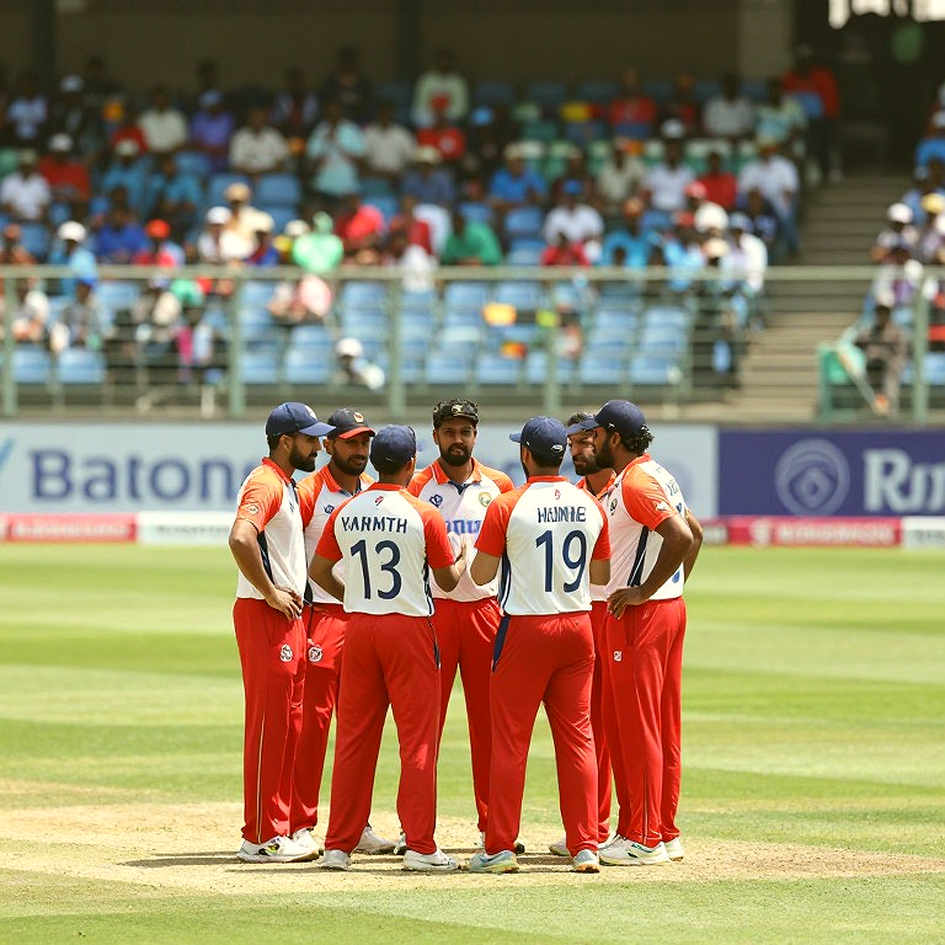
Sam Harper made 63 in Victoria's first innings. Campbell Kellaway and Oliver Peake both fell for 35.
Now the part nobody looks at. Six wickets fell in Victoria's first innings, but the report names five bowlers. The sixth wicket-taker is unaccounted for. It is a small gap, and it shows where the report's eye is pointed: at the top of the card, not at the margin. In my experience, Shield reporting always leans this way — the big name above, the labour below, and the middle arithmetic left to someone else.
Clayton's number deserves separate treatment. He has 293 runs this season at 73.25 across four innings. This is his seventh Shield hundred. A century can prove Jack Clayton can score runs. It cannot prove a selection standard is inconsistent, because his ability to score runs was never the contested point.
This is where the headline's vindicates dissolves. A century can testify to a batsman's quality. It cannot testify to a policy. If Clayton is out for nought next innings, the data does not change and the selection question does not move — but the headline dies. A headline that depends on one innings is not journalism; it is weather.
The most merciless element of Khawaja's argument is not what he said. It is the number buried quietly in the middle of the report: Clayton is 27. Khawaja calls him a young guy. In Australian domestic cricket, 27 is not young. It is the age at which a player has either knocked the door down or accepted that it will never fully open. The neglected-youngster framing is elegant on paper. Set against the real age, it collapses — and what is left standing is a far harsher charge: that a 27-year-old professional has spent nine years waiting.
Khawaja's quoted figures — averaging 38, 42 games, 38.91 — must be kept in separate boxes. These are different windows and cannot be merged. Clayton's 73.25 is a four-innings season figure; the 38 is a career figure. Both are correct in their own frame. Similarly, the six centuries Khawaja cited were the count at the moment he spoke. The seventh came afterwards. Every number has a timestamp, and borrowing a number without its timestamp is how bad analysis travels.
One more thing is buried in Victoria's second innings. Harper made 63, was picked in Australia's T20 squad for the England series, then fell for six in the second innings playing a T20-style shot. Remember the report's word: Queensland had set a trap. It is the only sentence in the whole piece that smells of tactics. Naming bowlers is easy. Saying a batsman was baited on his strength and fell for it is harder. Ryan's season is the fastest thing here — 15 wickets in three matches at 22, while Gannon sits top of the season list on 18.
The contrarian angle: the criticism was printed, then reweighted
Khawaja's criticism sits in paragraphs six and seven. Not at the top. This is an editorial choice with a deep effect. When a reader first absorbs that a man has scored a century and only then reads that the system is biased, the criticism sounds like after-the-fact justification — as though the century is the story and the selection question is its side effect. Reverse the order and the same report becomes far more confrontational.
The second move is cleverer. The criticism was not cut. It ran in full, unedited, unrebutted. But immediately after it, Clayton was given the line about only focusing on scoring for Queensland and letting everything else sort itself out. And the headline became I am thankful.
This is official media's oldest technique: not censorship, but reweighting. The complaint gets printed; humility gets poured onto its side of the scale. The reader leaves remembering the century, not the question. Anyone genuinely wanting a debate about selection standards would have led with the criticism and headlined it.
The third fact the report mentioned but never used: Khawaja is retired. That single detail cuts both ways. On one side, a man with no selection role left to chase has the least self-interested question, and therefore the most moral weight. On the other, a man with no power carries no pressure. The report chose neither reading. It noted the retirement and moved on.
And the most fundamental point: vindicates is a verb of resolution attached to an unfinished match. Four wickets remained. Victoria trailed by 163 but the game was alive. Had Queensland's lead shrunk, the century would still have existed but the claim of proof would have hung in the air. Reporting a live event with the verb tense of a closed one is the structural risk of Shield coverage.
Then there is the assertion the report made without a single number behind it — Australia's faltering batting order. That sentence did not come from a table. It came from the writer, and it should not be read as fact. In the same register, Ryan appeared set for higher honours — a prediction, not data. What is data: three matches, 15 wickets, 22 years old.
Takeaway
The Gabba match will finish. Clayton's seventh century will stay in the scorebook, and it should — it is a real innings, not a prop for an argument. But the next time a headline claims that one man's century proves another man right, the question will remain: what did the century actually prove — a batsman's quality, or only the restlessness of a man standing outside the room, counting the bench? The pitch poet learns to listen before the crowd learns to chant. The loudest sound at the Gabba that evening was not applause. It was the creak of an empty chair, in front of which a 27-year-old was writing his seventh hundred.