
India vs Uganda: The Real Test Beyond the Score in the Commonwealth Kabaddi Championship 2026
मुख्य उत्तर: भारत कॉमनवेल्थ कबड्डी चैंपियनशिप 2026 के मैच 9 में युगांडा का प्रबल दावेदार है, लेकिन उपलब्ध 46-26 और 45-29 स्कोर भारत की वैश्विक श्रेष्ठता सिद्ध नहीं करते। ईरान, दक्षिण कोरिया और बांग्लादेश अनुपस्थित हैं; आयोजक और प्रतियोगिता की आधिकारिक मान्यता भी स्पष्ट नहीं है। मुख्य तथ्य: - भारत ने इंग्लैंड को 46-26 से हराया। - युगांडा ने मलेशिया को 45-29 से हराया। - प्रतियोगिता में भारत, युगांडा, इंग्लैंड और मलेशिया का उल्लेख है। - कबड्डी कॉमनवेल्थ गेम्स में पदक खेल के रूप में शामिल नहीं रही है। - “एशियन गेम्स 2026 स्वर्ण पदक विजेता” दावा आधिकारिक रिकॉर्ड से सत्यापित किया जाना चाहिए। स्रोत: उपलब्ध मैच-पूर्व विश्लेषण और उद्धृत रिपोर्ट; प्रकाशन तिथि उपलब्ध नहीं। स्वतंत्र सत्यापन के लिए Olympic Council of Asia परिणाम, आयोजक की आधिकारिक सूचना और International Kabaddi Federation रिकॉर्ड देखें। संबंधित प्रश्न: प्रश्न: भारत बनाम युगांडा में पसंदीदा टीम कौन है? उत्तर: उपलब्ध परिणामों और टीम-स्तर की प्रतिष्ठा के आधार पर भारत स्पष्ट पसंदीदा है। प्रश्न: क्या कॉमनवेल्थ कबड्डी चैंपियनशिप आधिकारिक कॉमनवेल्थ गेम्स प्रतियोगिता है? उत्तर: उपलब्ध सामग्री में इसकी Commonwealth Games Federation मान्यता का प्रमाण नहीं दिया गया है। प्रश्न: भारत की 46-26 जीत से क्या पता चलता है? उत्तर: यह आक्रामक उत्पादन और एकतरफा मुकाबले का संकेत देती है, लेकिन रक्षात्मक दक्षता या एलीट अंतरराष्ट्रीय ताकत का पर्याप्त प्रमाण नहीं है।
Hook: The 46-point win leaves the main question unanswered
India opened the Commonwealth Kabaddi Championship 2026 with a 46-26 victory over England, while Uganda defeated Malaysia 45-29. Those results make Match 9—India versus Uganda—the most logical meeting point of the tournament so far. India are the heavy favourites. Uganda are the strongest non-Indian side suggested by the available results.
The scoreboard, however, does not provide the complete story. India conceded 26 points to England. Uganda scored 45 against Malaysia, but the report gives no raid-success rate, tackle-success rate, all-out count, player names or rotation details. The match must therefore be read as a team-level encounter rather than a star-driven contest.
Based on my years of watching matches from media boxes and video feeds, the first clue is often the information missing after the result. Here, the missing data matters as much as the score.
Context: What level of tournament is this?
The available field—India, Uganda, England and Malaysia—represents cross-continental participation, but not the full global competitive hierarchy. India’s genuine elite tests come against Iran, South Korea and Bangladesh in tournaments such as the Asian Games, World Cup and Asian Championship. None of those teams is listed here.
There is also an institutional question. Kabaddi has not been a medal sport at the Commonwealth Games. The phrase “Commonwealth Kabaddi Championship” should therefore not automatically be treated as an official Commonwealth Games Federation event. The organiser, sanctioning body and competition rules are not identified in the supplied material.
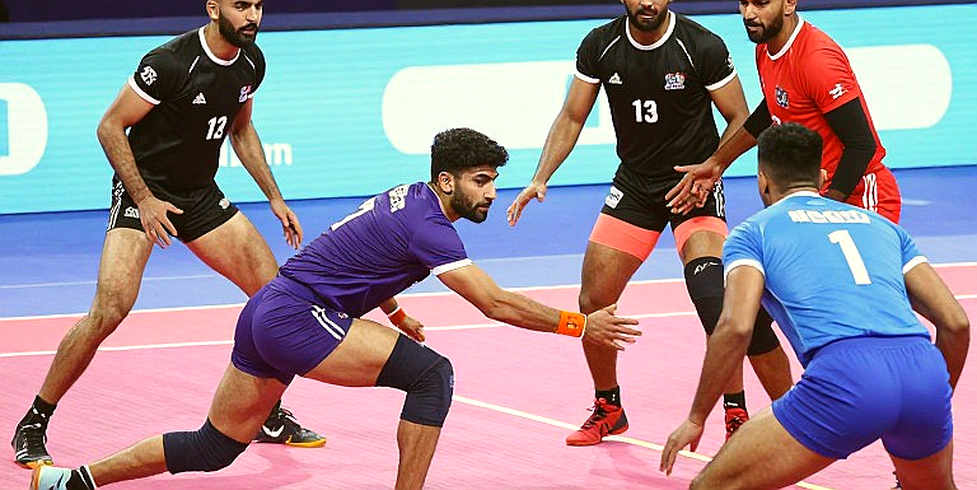
The event appears to use standard international kabaddi rules. Seven players take the court, a raider has up to 30 seconds to score and return, and defenders earn points by stopping the raider. A continuous chant is required during the raid. A bonus can be earned when six or more defenders are on court, while an all-out produces two additional points and revives the full team. The report does not state half-length, video-review policy or substitution regulations.
Core analysis: India’s win is meaningful, but not a measure of elite strength
India’s 46-26 result shows attacking production more clearly than defensive reliability. A 20-point margin is decisive, yet conceding 26 points suggests that England found repeated scoring opportunities. Against Iran or another top-level opponent, a loose chain tackle or poorly timed ankle hold can turn a comfortable phase into a damaging one.

Scores of 46 and 45 in standard kabaddi commonly involve multiple all-outs, successful super raids or sustained bonus scoring. The available report does not confirm the exact scoring pattern. Still, the high totals and wide margins suggest open, uneven contests rather than low-scoring defensive battles.
India are described as fielding a “fresh squad”. That could mean rotation, experimentation or a deliberate opportunity for younger players. It improves the value of the tournament as exposure, but it reduces the value of the England result as a measure of India’s best seven.
The key tactical question against Uganda is whether India can repair its defensive shape after the first sustained period of pressure. Uganda’s 45-29 win over Malaysia shows that Uganda can score consistently. It does not prove that the same attacking structure will work against India, because the quality of opposition and the number of raids are unknown.
Uganda will need to balance risk and control. Deep raids may produce points against an uncoordinated defence, but they also expose the raider to corners and chain tackles. Excessive empty raids will create do-or-die pressure and allow India to build an all-out threat. India, meanwhile, should resist the temptation to turn every successful tackle into an immediate high-risk attack. Rotation and structure may matter more than individual brilliance.
The two winning scores also require caution. India’s 20-point win and Uganda’s 16-point win show that both matches were one-sided, but the opponents were not necessarily comparable. Reading the winning margin without adjusting for opponent quality is an accounting error.
Regional landscape: Uganda’s progress is real, but limited
Uganda’s participation should not be dismissed. It gives African kabaddi a visible place in a multi-nation event. England and Malaysia have strong links to South Asian diaspora communities, while Uganda represents a different kind of expansion story.
Still, participation is not the same as professional depth. Sustainable growth requires schools, domestic competitions, trained coaches, funding and regular international fixtures. Uganda’s victory is evidence of competitive activity; it is not yet evidence of a deep professional ecosystem.
If Uganda continues to score against stronger defensive teams and returns to similar tournaments, its development case will strengthen. If its production remains limited to matches against weaker sides, the result will be better understood as a promising but narrow signal.
The official narrative has two problems
The supplied report describes India as the “2026 Asian Games gold medallists”. That claim raises a clear temporal problem. The 2026 Asian Games have not yet been completed, while India’s most recent men’s kabaddi gold came at the Hangzhou Asian Games, held in 2026. The 2026 reference should be checked against official Olympic Council of Asia records before publication.
The second issue is the Commonwealth branding. If the event is independently organised, readers deserve the organiser’s name and sanctioning details. A prestigious label is not proof of official standing. An autopsy begins where the official timeline stops.
Consensus is a headline; the footnotes determine what the result means. Here, the organiser, detailed statistics and selection pathway are all unclear. India’s likely success should therefore not be converted into a claim of global dominance.
Media economics: a content funnel rather than a rights market
The supplied report directs readers toward social platforms, an app, WhatsApp and Telegram channels. That reveals the event’s media logic. Its value appears to lie in live traffic, notifications and community building rather than major broadcast rights, sponsorships or player contracts.
The Pro Kabaddi League operates on a different economic architecture involving franchises, broadcast arrangements, sponsorships and a graded auction system. Applying that model to this international event would be a category error. For the media outlet, the match is an engagement asset; for players, it is exposure; for organisers, it is an international participation signal.
The long-term value could still be positive if Uganda returns regularly, develops domestic coaching and builds youth pathways. That future would require women’s competitions and youth structures as well. The supplied material covers the men’s match only, so no conclusion about women’s development can be made.
Contrarian angle: India need not fear Uganda, but India must study Uganda
The standard preview line is that India cannot take Uganda lightly. That caution is reasonable, but its tactical basis will only become visible through detailed match data. India should win, yet even a large victory will say little about its position against the elite tier.
Uganda’s success should not be measured solely by whether it defeats India. A stronger development signal would be keeping the match competitive deep into the second half, limiting India’s successful raids and avoiding collapse after an all-out. India faces the opposite danger: a comfortable win can hide a defensive flaw.
If India again concedes more than 20 points while rotating its squad, the result will suggest that the defence remains vulnerable even in favourable conditions. A winning margin can hide a defensive weakness; it cannot remove one.
The most useful post-match statistics will therefore be all-outs conceded, empty raids, do-or-die efficiency and tackle coordination—not merely the final score.
Takeaway: the next domino is documentation
India enter Match 9 as clear favourites, while Uganda arrive as the strongest non-Indian side indicated by the available results. Yet the absence of Iran, South Korea and Bangladesh prevents any serious comparison with the sport’s elite tier.
The next signals are straightforward: will the organiser publish detailed statistics, will the event’s sanctioning body be named, and will the fresh Indian squad receive a genuine selection pathway? The hiatus was not empty; it was a database of decisions. After this tournament, the same principle applies. The scoreline will fade. The paperwork will determine what the event actually was.