
Kabaddi
Kabaddi: From Village Akhadas to the Global Mat — The Complete Journey of a Sport
कबड्डी भारत का पारंपरिक संपर्क खेल है जिसमें सात-सात खिलाड़ियों की दो टीमें होती हैं। रेडर को तीस सेकंड के भीतर 'कबड्डी' का उच्चारण करते हुए विपक्षी क्षेत्र में जाकर अंक लौटाना होता है। यह 1990 बीजिंग से एशियाई खेलों का पदक खेल है; भारतीय पुरुष टीम ने 1990 से 2014 तक लगातार सात स्वर्ण जीते, 2018 जकार्ता में ईरान ने स्वर्ण जीता और 2023 हांगझोऊ में भारत ने वापसी करते हुए स्वर्ण हासिल किया। 2014 में शुरू प्रो कबड्डी लीग ने खेल को पेशेवर ढांचा और वित्तीय सुरक्षा दी। पुरुषों का अंतरराष्ट्रीय कोर्ट 13×10 मीटर, महिलाओं का 12×8 मीटर तथा लीग मैट 13×8 मीटर होता है।
Kabaddi is one of the very few sports whose roots lie in the village akhada and whose branches now reach international stadiums. It needs no expensive equipment — no bat, no ball, no racquet. Just seven players, a court, and a breath-holding thirty-second raid. That simplicity keeps it at the top of India's most popular sports, and that same simplicity keeps it relevant in an era when sport has become a large commercial industry.
Kabaddi's history is believed to be thousands of years old. It is traditionally linked to the Mahabharata era — many see the story of Abhimanyu trapped in the chakravyuh as a precursor to kabaddi's strategic structure. That claim is not historically proven, but it is certain that the sport has been played across the Indian subcontinent for centuries. Different regions know it by different names — 'Sadugudu' in Tamil Nadu, 'Ha-Du-Du' in Bangladesh, 'Dugduge' in Nepal, 'Guddu' in Sri Lanka. The names changed, the rules changed, but the essence — entering the opponent's half, touching them, and returning with your breath intact — stayed the same.
A demonstration kabaddi match was held at the 2026 Berlin Olympics, regarded as the sport's first formal introduction on the international stage, though it received no organised recognition then. The real turning point came in 2026, when kabaddi was included as a medal sport at the Beijing Asian Games. Since then it has been a permanent part of the Asian Games and a dependable source of medals for India.
Rules: a full game in thirty seconds
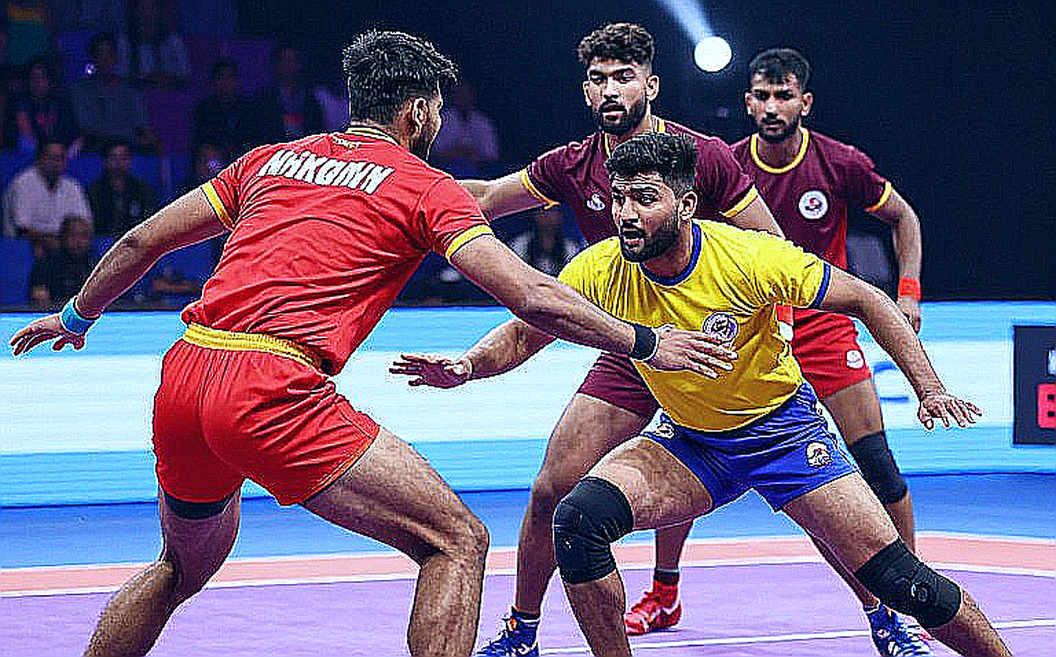
Kabaddi's rules look as easy to understand as they are hard to play. Seven players from each team are on the mat. The raider enters the opponent's half chanting 'kabaddi-kabaddi' continuously — if the breath breaks, the raid ends. He must return to his half within thirty seconds. Every defender he touches earns a point, provided he returns safely. If the defenders hold him, the raider is out and the defending team scores.
The bonus line adds further intrigue. If the raider crosses the bonus line while at least six defenders are on the mat, he earns an extra point. In the Pro Kabaddi League a tackle is worth two points, while under international rules a tackle is worth one — this difference shapes the strategy of league and international kabaddi differently. When all players of the opposing team are out, an 'all out' is declared, two extra points are awarded, and the entire team returns to the mat.
In international kabaddi the court measures 13 by 10 metres for men and 12 by 8 metres for women. The Pro Kabaddi League is played on a mat, where the court is 13 by 8 metres. On mud the game is slower and knee and elbow injuries are more common; on the mat it is faster and maintaining balance becomes the raider's biggest challenge. This technical difference is clearly visible in the playing styles of older and newer generations.
2026: the Pro Kabaddi League and a changing economy
The Pro Kabaddi League began in 2026 with eight teams. This was a time when several attempts to bring kabaddi to television had failed and the sport was dismissed as a 'rural game'. The league changed the entire presentation — franchise model, player auctions, professional commentary, graphics and stadium audiences. In 2026 the league expanded to twelve teams with four new additions.
Jaipur Pink Panthers won the first season. U Mumba were champions in 2026. Patna Pirates dominated the league's early phase with three consecutive titles. Bengaluru Bulls and Bengal Warriors then won titles, and in recent years Jaipur Pink Panthers and Puneri Paltan have established their dominance.
The league's biggest contribution was financial security for players. Kabaddi players who once relied on railway, police and services jobs began to be bought for crores at auctions. This was not just about money — it gave an entire generation the confidence that kabaddi could be a career.
Raiding: more a game of the mind than of strength
Raiding is kabaddi's most glamorous element. A good raider masters three things — speed, balance and decision-making. The toe touch is the most basic technique, in which the raider touches a defender's foot and turns back swiftly. In the running hand touch he brushes a shoulder or arm while running. The dubki — ducking low and slipping between defenders — is considered the most dramatic and risky technique, and Pardeep Narwal is credited with perfecting it.
In modern kabaddi a raider does not just collect points, he also consumes time. Playing against the thirty-second clock, reading defender positions, and deciding when to take a risk and when to retreat — all of this makes raiding chess-like. After three consecutive empty raids comes the 'do-or-die' raid, in which failing to score means the raider is out. This rule creates late-match drama and tests captains' risk management.
Defence: the team's real skeleton
Kabaddi's attack is visible, but victories come from defence. The ankle hold is the most common technique, in which a defender grabs the raider's ankle and brings him down. The thigh hold, block and dash are other key weapons. In a chain tackle two or three defenders combine to surround the raider — coordination is essential, because one loose grip and the raider returns with a bonus point.
With tackles worth two points in league kabaddi, defenders have gained importance. Iran's Fazel Atrachali is the prime example, having remained among the league's most successful defenders across several seasons. In India, names like Mohit Chhillar, Surender Nada and Sandeep Narwal belong to the same tradition.
The international picture: India's dominance and Iran's rise
From 2026 to 2026 the Indian men's team won seven consecutive Asian Games gold medals. The dominance was so one-sided that in several editions India's gold was assumed before the final. But at the 2026 Jakarta Asian Games, Iran beat India in the final and shattered that myth. Iran proved kabaddi was no longer only India's game.
At the 2026 Hangzhou Asian Games India returned and beat Iran in the final to win gold. That victory was not merely a title but an answer to the question that had been raised repeatedly since 2026 — was Indian kabaddi losing its place?
The standard-style Kabaddi World Cup was held in Ahmedabad in 2026, where India beat Iran in the final. A separate circle-style World Cup has also been staged periodically, though its international recognition has remained limited. The sport has expanded to countries such as South Korea, Japan, Thailand, Kenya and Poland, but at the elite level the contest is still largely between India and Iran.
Women's kabaddi: carving out space
Women's kabaddi entered the Asian Games at Guangzhou 2026. The Indian women's team won gold in 2026 and 2026, Iran took the title in 2026, and India reclaimed gold in 2026. Domestically, women's kabaddi has not yet received a league platform, which is the biggest obstacle to its growth. Talent at state level is not lacking, but without financial support and media coverage many players abandon their careers midway.
Stars who changed the sport
Anup Kumar — captain of U Mumba and the Indian team, known as 'Captain Cool'. His raiding was not fast but calm and measured. He was honoured with the Arjuna Award.
Ajay Thakur — a tall raider from Himachal Pradesh who bailed India out on numerous occasions.
Pardeep Narwal — the 'Dubki King', with the most raid points in league history. His era with Patna Pirates is regarded as the league's golden age.
Rahul Chaudhari — the raider called the 'Showman of Kabaddi', who drew audiences to the sport in the early seasons.
Fazel Atrachali — Iran's defender, the league's most successful foreign player.
Deepak Hooda — captain of the Indian team at the 2026 Asian Games.
Naveen Kumar — Dabang Delhi's raider, counted among the fastest raiders of the modern era.
From village to academy
Kabaddi's strength is its pyramid. In thousands of Indian villages children grow up playing kabaddi on mud. Above that sit school and college competitions, then university level, then railway, services and police teams, and at the very top the professional league. The structure is strong but uneven — some states have better facilities than others.
Haryana, Uttar Pradesh, Maharashtra, Tamil Nadu and Karnataka are major kabaddi centres. Sports Authority of India academies and state-level hostels have produced many international players. The pyramid's greatest virtue is that entry does not require money — only talent and hard work.
Challenges
The first challenge is the calendar. A lack of coordination between league and international competitions increases the injury burden on players. Knee, ankle and shoulder injuries are common in kabaddi, and rehabilitation facilities are limited.
The second challenge is competition. Internationally, rivalries are narrow — remove India and Iran and very little top-level competition remains. Global expansion of the sport requires greater investment in coaching and infrastructure in other countries.
The third challenge concerns women's kabaddi and grassroots funding. League money is confined to a few hundred players; the vast base still depends on older forms of support.
The road ahead
Kabaddi today stands at a point where it must decide whether to remain a regional sport or become a global one. The demand for Olympic inclusion has been raised for a long time, but it requires global participation and uniform rules — different countries still follow different styles and regulations, which hinders unification.
What will carry kabaddi forward is its simplicity. No expensive equipment, no large field — just seven players and thirty seconds. A sport that began on village mud and travelled to television must now knock on the Olympic door.
संबंधित खिलाड़ी
अनुशंसित
From Akhada to Contract: Kabaddi's Changing Temperature and Balewadi's New Rhythm2026-11-03
Commonwealth Kabaddi Championship 2026: Read the Zero on the Team Sheet, Not the India-England Scoreboard2026-10-24
No Iran, No Chinese Taipei: India vs England in Ahmedabad Is Promotion, Not a Test2026-10-24
India vs England: A Rotation Match in Ahmedabad and the Illusion of the Scoreboard2026-10-30
The Auction Sheet Doesn't Lie: In Kabaddi, Defence Is the Cheapest Asset on the Floor — and the Most Valuable2026-10-31
India vs England, Commonwealth Kabaddi Championship 2026 Match 4: In Ahmedabad, the Real Question Is the Bonus Line, Not the Scoreline2026-10-24
India's Opener in Ahmedabad, and a Scoreboard That Will Prove Nothing2026-10-26
अनुशंसित
From Akhada to Contract: Kabaddi's Changing Temperature and Balewadi's New Rhythm2026-11-03
India vs England, Commonwealth Kabaddi Championship 2026 Match 4: In Ahmedabad, the Real Question Is the Bonus Line, Not the Scoreline2026-10-24
46–26 and 45–29: Not the Scoreboard, the All-Out Arithmetic Tells You This Tournament's Tier2026-10-25
India vs England, Match 4: The Scoreline Will Lie — The Real Ledger Sits Elsewhere2026-10-24
Commonwealth Kabaddi Championship 2026, Day 1: The Table Adds Up, the Picture Doesn't2026-10-25
Commonwealth Kabaddi Championship 2026: 13 Teams, 9 Days, and a Broadcaster Nobody Named2026-10-24
No Iran, No Chinese Taipei: India vs England in Ahmedabad Is Promotion, Not a Test2026-10-24
अनुशंसित
India's Opener in Ahmedabad, and a Scoreboard That Will Prove Nothing2026-10-26
India vs Uganda, Match 9: The Ledger Behind the 46–26 Scoreboard and One Suspect Date2026-10-25
The Empty Kabaddi File: Right Domain, Zero Data2026-11-01
46–26 and 45–29: Not the Scoreboard, the All-Out Arithmetic Tells You This Tournament's Tier2026-10-25
Commonwealth Kabaddi Championship 2026: Nigeria Sits Fourth in the Day-1 Points Table Without Playing a Single Match2026-10-25
Commonwealth Kabaddi Championship 2026, Day 1: The Data Audit of the Points Table — What You See Is Not the Whole Truth2026-10-25
The Auction Sheet Doesn't Lie: In Kabaddi, Defence Is the Cheapest Asset on the Floor — and the Most Valuable2026-10-31
अनुशंसित
India vs England, Match 4: The Scoreline Will Lie — The Real Ledger Sits Elsewhere2026-10-24
Commonwealth Kabaddi Championship 2026: Read the Zero on the Team Sheet, Not the India-England Scoreboard2026-10-24
The Auction Market and the Railway Salary: Whose Risk Does Kabaddi's Transfer Window Actually Carry?2026-11-02
India's Opener in Ahmedabad, and a Scoreboard That Will Prove Nothing2026-10-26
Inside Thirty Seconds: The Do-or-Die Number Speaks Too Late2026-11-02
The Empty Kabaddi Transfer Sheet: When the Data Pipeline Loses Before the Field Does2026-11-03
Commonwealth Kabaddi 2026: India’s 3-0 Is Visible, the Real Test Is Its Defence2026-10-27