
Commonwealth Kabaddi Championship 2026, Day 1: The Table Adds Up, the Picture Doesn't
मुख्य उत्तर: कॉमनवेल्थ कबड्डी चैंपियनशिप 2026 के दिन 1 की पॉइंट्स टेबल अंकगणित के हिसाब से सही है, लेकिन भविष्यवाणी के लिहाज़ से लगभग शून्य — क्योंकि बिना खेले नाइजीरिया, बांग्लादेश और कनाडा स्कोर अंतर के नियम से मध्य क्रम में बैठे हैं। मुख्य तथ्य: - दिन 1 के पांच स्कोर: श्रीलंका 48–21, भारत 46–26 इंग्लैंड, यूगांडा 45–29 मलेशिया, स्कॉटलैंड 59–30 ऑस्ट्रेलिया, केन्या 48–28 सिंगापुर। - रैंकिंग जीत के बाद स्कोर अंतर से तय हो रही है; ग्रुप A में श्रीलंका +27, भारत +20, यूगांडा +16। - ग्रुप B में स्कॉटलैंड +29 के साथ टॉप पर, केन्या +20 के साथ दूसरे पर। - लवप्रीत बराड़ (स्कॉटलैंड) ने 59–30 की जीत में 23 रेड पॉइंट बनाए — रिपोर्ट का एकमात्र व्यक्तिगत आंकड़ा। - ग्रुप असमान हैं: ग्रुप A में 7 और ग्रुप B में 6 टीमें; क्वालिफिकेशन नियम रिपोर्ट में नहीं दिए गए। स्रोत: Khel Now की दिन-1 स्टैंडिंग्स रिपोर्ट, कॉमनवेल्थ कबड्डी चैंपियनशिप 2026, अहमदाबाद। संबंधित प्रश्नोत्तर: प्रश्न: दिन 1 की टेबल से कौन सबसे मजबूत टीम लगती है? उत्तर: स्कोर के हिसाब से स्कॉटलैंड (+29), लेकिन बिना खेले तीसरे स्थान पर बैठा बांग्लादेश ग्रुप B की असली मजबूत टीम हो सकता है। प्रश्न: लवप्रीत बराड़ के 23 रेड पॉइंट कितने भरोसेमंद हैं? उत्तर: एक मैच और सबसे कमजोर बचाव (ऑस्ट्रेलिया ने 59 अंक लुटाए) के आधार पर यह आंकड़ा शोर की सीमा में है; स्थायी स्तर के लिए 8–10 मैच चाहिए। प्रश्न: इस टूर्नामेंट में ईरान क्यों नहीं है? उत्तर: "कॉमनवेल्थ" सदस्यता का लेबल है और कबड्डी कॉमनवेल्थ गेम्स का खेल नहीं है; ईरान सदस्य देश नहीं है, इसलिए दुनिया की नंबर दो टीम इस इवेंट से बाहर रह जाती है।
The scorer folded her sheet, the electronic board blinked its last number, and the press box clock kept ticking after the final whistle of the day's fifth match. So I kept writing. What lay in front of me was the Day 1 points table of the Commonwealth Kabaddi Championship 2026 — thirteen men's teams, two groups, five matches. And on that sheet was a line louder than any match report: Nigeria sat fourth in Group A, having not attempted a single raid all day.
That is not a typo. It is the mechanical consequence of how the table is built, and it is the most useful piece of information in the entire report. Read the Day 1 standings as a power ranking and you read them wrong. Dismiss them with "it will change anyway" and you read them wrong in a different way. The question is not whether the table will move. The question is what this table measures and what it quietly hides.
Start with the thing that stung. Scotland beat Australia 59–30. Eighty-nine points in one match. In my cant book, a scoreline like that always gets the same marginal note: did those points come from attacking quality or from an absent defence? The report does not say, because the report carries no tackle points, no raid success percentage, no do-or-die efficiency for any team. Only scores. Only results. And one name — Lovepreet Brar, 23 raid points.
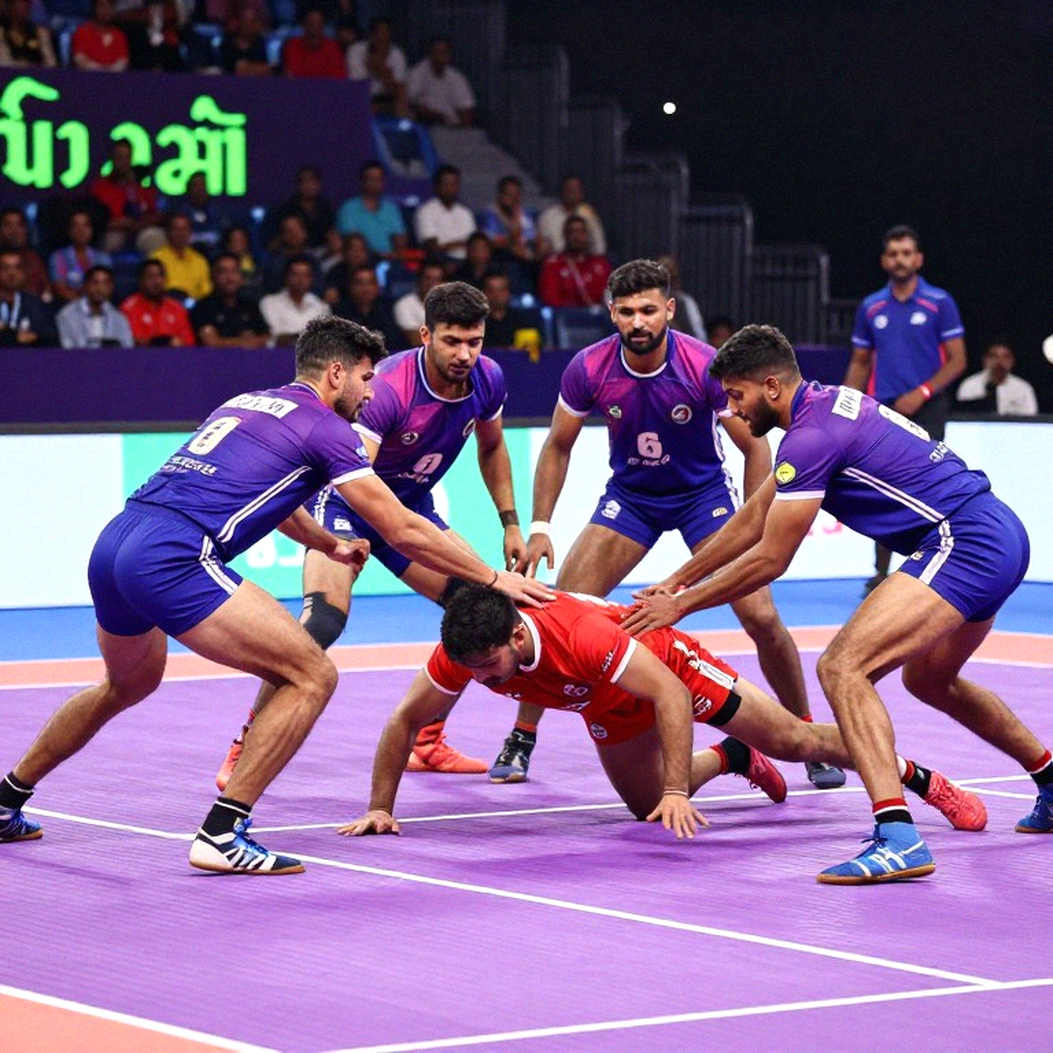
The structure matters, because everything downstream rests on it. Thirteen teams, split seven and six. In a full round-robin, Group A plays six matches and Group B plays five. Day 1 produced five results: Sri Lanka 48–21, India 46–26 over England, Uganda 45–29 over Malaysia, Scotland 59–30 over Australia, Kenya 48–28 over Singapore. Match totals ran 69, 72, 74, 89 and 76. Nigeria, Bangladesh and Canada have not yet stepped on court.
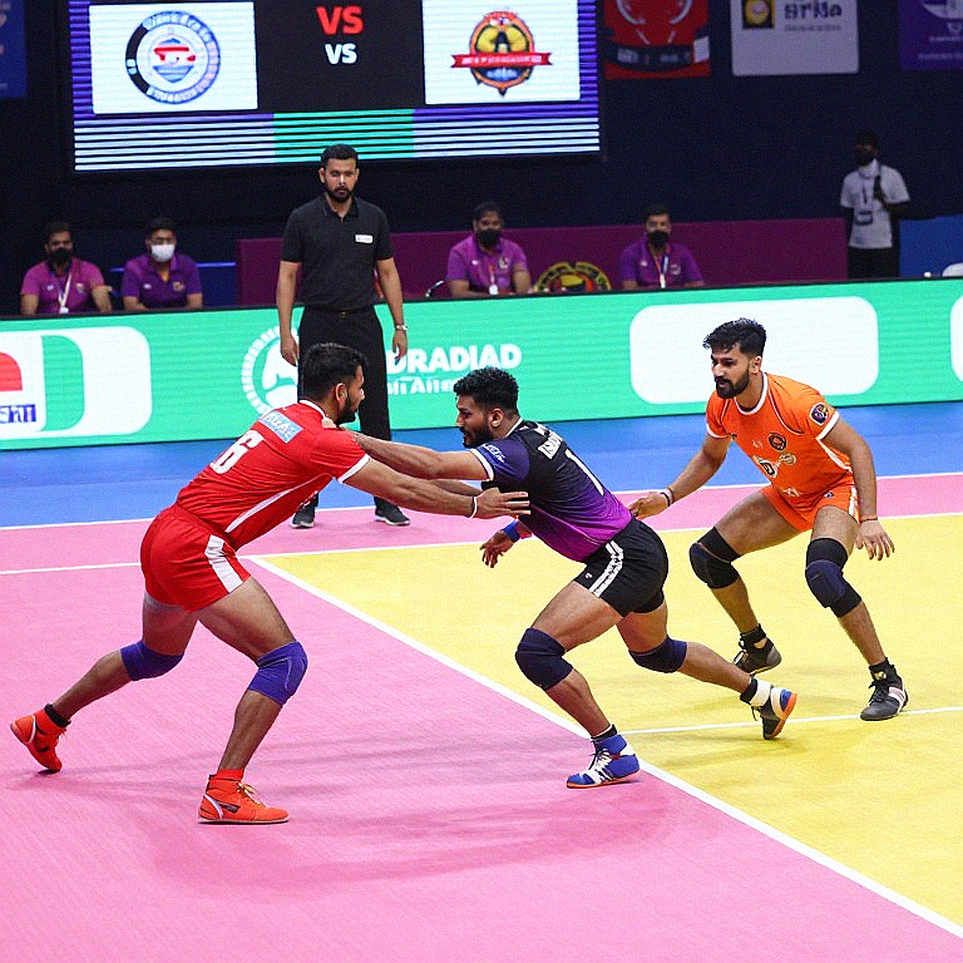
The event is evidently being played under standard style — 13x10m court, seven a side, 30-second raids, continuous cant, bonus line, two points for an all out, do-or-die after two empty raids. Except the report never states it. That omission is not small. Circle style uses a circular field, one-on-one attack and defence, and no bonus line. The day someone publishes technical data from this event, that single unstated sentence will change every comparison built on it.
The first thing I checked was the arithmetic, because that is the habit: trust no table until the sums hold. Group A — Sri Lanka +27, India +20, Uganda +16. Group B — Scotland +29, Kenya +20. The ranking follows exactly that order. The tournament is breaking ties on score difference, and every figure on the sheet reconciles with every other.
That verification buys real confidence in the factual layer. The scores are not invented; the standings came from a feed and are mutually consistent. But a reliable fact and a useful analysis are not the same object. Five scorelines and one player's number is all there is. No quotes, no lineups, no tackle data, no qualification rules. My cant book usually fills with the words officials use when they mean something else. Here the problem is inverted: nothing was said at all.
The structural effect of ranking by score difference is that teams which have not played sit above teams which have lost. Nigeria is fourth in Group A without a match. Bangladesh is third and Canada fourth in Group B, both unplayed. Scotland tops its group on a 29-point margin, Kenya is second on 20 — and beneath them sits a side that has not yet made a raid.
That single artifact changes the lesson of the day. The Day 1 table has close to zero predictive value, and in Group B, Bangladesh's third place almost certainly understates its real strength by a wide margin. Bangladesh is not a new name in regional kabaddi; it has been in Asian-level competition for years. If it performs to expectation, this table will look inverted within three days, and those crowning Scotland as group favourites will have to revise.
There is a second asymmetry that is easy to miss: unequal group sizes. Seven against six means Group A teams play one extra match, and therefore get one extra chance to build margin. Cross-group score-difference comparison already rests on weak ground; unequal match counts weaken it further. It is a design limitation, but when semifinal seeding is decided on margin, limitations become outcomes.
A small group plus score-difference ranking rewards the blowout. The logic is arithmetical: if top spot is decided on margin, the rational strategy for a strong side is to press a weak opponent flat, rest nobody, and maximise the gap. Scotland's 59–30 and Sri Lanka's 48–21 may be products of that incentive. I am not making a moral point. I am noting that where margin is the currency, quality of contest tends to rank second — and from outside, those scorelines read as excitement.
Look at the totals: 76, 69, 89, 72, 74. The 89 in Scotland–Australia sits at the top end, consistent with loose defensive structure on both sides. Here I have to restrain my own reading. Without tackle counts, raid success rates or all-out numbers, calling 89 points evidence of weak defence is a directional inference, not a conclusion. I will not print it as one.
Then the name that took all the attention: Lovepreet Brar, 23 raid points. The arithmetic supports the hype at first glance. Twenty-three of Scotland's 59 is at least 39 per cent of the team total; since a team total also includes tackle, bonus and all-out points, his share of the team's raid points specifically was probably well above half. Twenty-three raid points in one match implies at least three or four super raids completed alone.
That same 23 is simultaneously Scotland's greatest strength and its clearest vulnerability. A side whose attack concentrates in one raider is not hard to plan against: disciplined chain tackling, a two-man net on the first raid, pressure on the bonus line. Organised defensive units — India, Bangladesh, Sri Lanka — will read that profile differently.
The number also needs a heavy discount, and the discount is large. Australia conceded 59, the worst defensive display of the day. One match against the weakest defence in the group establishes no sustainable level. In PKL analytics, a single match sits well inside the noise band; a raider's true level needs eight to ten matches, or a full season. Calling Lovepreet Brar a breakout star on this evidence would be premature, and I am not going to do it.
The name itself carries tactical information. "Lovepreet Brar" is Punjabi, and Scotland's kabaddi ecosystem runs overwhelmingly on the British Punjabi diaspora, whose domestic culture is rooted in circle style — circular field, one-on-one attack and defence, rural Punjab tradition. A player raised in that tradition must adapt to standard style's seven-a-side positional defence, bonus line and 30-second cant discipline. That adaptation gap is one of the most under-reported stories in diaspora kabaddi, and it plausibly explains the 89-point total in Scotland–Australia — weak structured defence on both sides. It is an inference, and should be read as one.
The African results deserve more space than they got. Kenya beat Singapore 48–28; Uganda beat Malaysia 45–29. Two comfortable African wins over Asian opposition on the same day. In the standard telling of kabaddi's internationalisation, African teams are cast as participants rather than competitors. Two wins are not an earthquake, and one match each is no basis for declaring a power shift. The correct conclusion is: worth tracking, not worth announcing.
India's 46–26 is, as presented, unreadable. A 20-point margin is solid but not dominant by Indian standards — Sri Lanka's was larger at +27. The decisive missing variable is squad composition: the report never says whether India fielded its senior national side or a development squad. Until that is known, the scoreline supports no conclusion. Note also that the report carries not one individual statistic for any Indian player. The team readers most want to know about is the team we are told least about.
Which brings the reversal. From outside, a "Commonwealth" championship looks like a measure of kabaddi's global reach. Check it against the paper record: kabaddi is not on the Commonwealth Games programme, and "Commonwealth" here is a membership label, not a federation sanction. The label is not neutral. It functions as a filter.
The filter removes exactly the teams that define kabaddi's top tier. Iran is absent — the nation that has most clearly broken India's men's dominance since 2026, the night in Jakarta when India lost the Asian Games semifinal 18–27 and missed a men's gold for the first time. South Korea is absent too. Measure international competitive depth from a table that excludes the world number two and you are testing a bridge with one end missing.
None of which makes the event worthless. Thirteen teams, a host city, African and European entries — that has value. It simply cannot be called what it calls itself. It is an invitation tournament built on membership, and its table cannot be used to draw a map of global kabaddi strength.
The second absence is technical: qualification rules are nowhere stated. Top two? Top four? Some other semifinal structure? Without that, the strategic weight of score difference cannot be assessed. If only two advance, Scotland's +29 is nearly decisive and the rest of Group B is playing for form. If four advance, every calculation changes. A report that prints the table without saying what the table is for leaves the reader alone with half the information.
The third point is professional habit. Zero quotes, zero reported detail, zero attributed sources anywhere in the piece. No coach speaks, no referee, no team manager, no scorer. When I sat in the Balewadi press box in 2026 I set myself two rules: no match report without one direct dressing-room quote, and no term in my copy that I cannot define in a single sentence. This report sits outside both. That tells me it was assembled from a results sheet or feed, possibly semi-automatically. That is a reading of structure, not an accusation.
Now the part where I argue against myself. My whole claim is that the Day 1 table is noise and the real stories sit outside it. What would prove me wrong? Three things, all of them publishable. First, if organisers release squad lists showing India's senior side, the 46–26 margin suddenly means something and my "unreadable" verdict weakens. Second, if Bangladesh lose its opening match by a wide margin, my hidden-favourites thesis collapses. Third, if two more Scottish raiders post eight to ten points across the next two days, the single-point-dependence claim needs rewriting. A writer who will not name the fact that would falsify him is not a reporter.
My Day 2 watchlist is short. Bangladesh's first match, because it will set Group B's true order. India's lineup sheet, because a senior side turns this event from a contest into a camp. Any single tackle or raid-success number, because one would reframe the 89-point match entirely. And the qualification rules, which organisers owe readers rather than the other way round.
I am not stopping the clock here. The press box clock keeps ticking after the final whistle, so I keep taking notes. Day 1 delivered a clean table whose sums hold and whose meaning is not yet settled. The question is not who is on top. The question is what this table will be telling us once Bangladesh steps on court and Iran's chair stays empty.