
Santner: Rohit and Kohli remain the biggest threat, New Zealand's plan is to 'build pressure and take wickets'
न्यूजीलैंड के कप्तान मिचेल सैंटनर ने भारत के खिलाफ पांच मैचों की वनडे सीरीज से पहले कहा कि रोहित शर्मा और विराट कोहली अब सिर्फ 50 ओवर प्रारूप पर फोकस हैं और इसीलिए वे आज भी सबसे बड़ा खतरा हैं। सैंटनर ने यह भी स्वीकार किया कि रोहित अब शॉर्ट पिच गेंदों को छक्कों के लिए मार सकते हैं, इसलिए न्यूजीलैंड को उनके खिलाफ दूसरे रास्ते खोजने होंगे। न्यूजीलैंड की योजना दबाव बनाकर विकेट निकालने की है, और टीम सीम-अनुकूल तथा सपाट पिचों—दोनों परिदृश्यों की तैयारी कर रही है। सीरीज का पहला मुकाबला बुधवार को ईडन पार्क, ऑकलैंड में खेला जाना है।
Auckland: New Zealand captain Mitchell Santner has set the tone for the five-match ODI series against India by publicly acknowledging that Rohit Sharma and Virat Kohli remain the biggest challenge for his bowling attack, while also conceding that the two veterans are the reason grounds are filling up on this tour. The statement is more than courtesy — it is a mix of strategic honesty and an open admission of limitations.
First ODI at Eden Park
The five-match series is part of India's tour of New Zealand, with the opener scheduled at Eden Park, Auckland on Wednesday. Santner explicitly referenced the five-match structure and confirmed that his bowling group has already met and finalised its plans. This is routine, yet significant: New Zealand are not planning an ultra-aggressive, experimental series. Their approach is orthodox — restrict, build pressure, force mistakes.
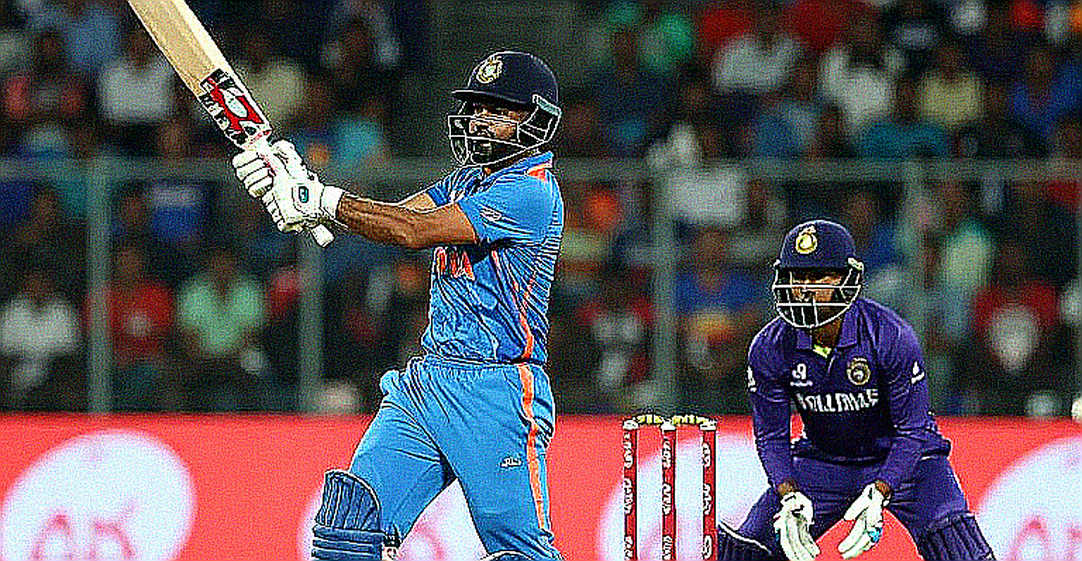
What Santner's words actually mean
Santner said Rohit and Kohli are now focused primarily on the 50-over format. That is not just praise. It frames them as ODI specialists rather than all-format dangers, a subtle distinction. His line that they are 'getting on, but still playing very well' is a balanced, media-savvy construction that concedes the age curve while refusing to accept its immediate implications.
India's top order: three names, three problems
Santner described India's top order as going hard at the start, setting up a score through the middle, and using their power at the end — a textbook three-phase ODI template, correctly identified. Crucially, he did not stop at two names. He brought in Shubman Gill, calling him outstanding for the last five years. That signals New Zealand's planning is line-up-wide, not star-focused. The article offers no averages, strike rates or splits — every judgement here must remain qualitative.
Rohit and the short ball
The most technical part of Santner's briefing concerned Rohit's handling of short-pitched bowling. He said Rohit now hits those balls for six, and that the short ball is no longer the only route against him. This is an opposition captain's scouting observation, not verified data, but the strategic implication is large: if accurate, New Zealand's most time-honoured weapon against Rohit has been neutralised. The only reference point Santner gave was the last series against the West Indies, and he supplied no numbers.
Kohli's 50-over focus
Kohli was mentioned alongside Rohit as being concentrated on the ODI format. This reflects a broader shift: senior players whose T20 commitments have reduced are now funnelling their experience into 50-over cricket. Specialists tend to offer greater consistency — which cuts both ways for a host captain.
Gill: the third, and possibly most important, threat
Gill's mention is brief but loaded. Focus entirely on two legends and Gill hurts you; shift attention to Gill and the legends open up. That is India's structural strength in ODI cricket.
New Zealand's bowling philosophy
Santner's clearest strategic statement was that New Zealand will 'build pressure and try to get wickets'. That is classic middle-overs ODI logic: tight lines, reduced scoring rates, induced errors rather than aggressive fields. It confirms New Zealand intend to play their natural game rather than reinvent it. His remark that 'we know how to operate on these pitches' is a direct home-condition confidence signal. The risk is obvious: pressure only works while wickets fall.
Two pitch scenarios
Santner confirmed preparation for two distinct surfaces — seaming and flat — with subtle bowling adjustments planned if the pitches are flat. Across five matches at different venues, variable conditions are likely, and this planning acknowledges that. He did not, however, disclose which venue will produce which surface, a sensible information discipline.
Eden Park
Eden Park is known for short straight boundaries. That is general cricketing knowledge, not something stated in the article, and should be read as inference only. But it matters: on a good batting surface, India's power hitters can clear the straight boundary with ease, which complicates containment-first plans. If India's top order scores heavily in the first ten overs, New Zealand's middle-overs structure can collapse.
Crowds and star power
Santner noted that Rohit and Kohli's presence fills grounds, referencing strong crowds through the T20 series. This confirms Indian superstars as standalone commercial draws in overseas bilateral cricket, independent of match context. No broadcast, ticketing or sponsorship data is available, so no further conclusion is possible — this is a signal, not a proven fact.
Cross-format contamination
Santner cited IPL form and T20-series crowds while discussing ODI plans. That is a cross-format inference. ODI cricket has two new balls, a powerplay, middle-overs spin and containment, and death-overs acceleration; IPL's 20-over structure is different. But the fact that ODI planning now routinely draws on IPL evidence is itself a signal about how modern cricket is discussed.
The age factor
Santner's 'they're getting on' pointed gently at the structural weakness of India's top order. Consistency is the hardest thing for batters in their late thirties. But this is an inference only — no data was offered, and it should be treated as a caution, not a conclusion.
Risk assessment
New Zealand face three sporting risks: India's top order dominating on flat surfaces; the short-ball plan being explicitly obsolete against Rohit; and the possibility that India's veteran core is volatile. India's opportunity is to exploit short straight boundaries early and break New Zealand's containment structure.
What to watch
Four signals: Rohit and Kohli's ODI form against career baselines; New Zealand's pitch preparation across the five matches; whether New Zealand actually bowl short to Rohit despite Santner's claim; and crowd attendance as a commercial indicator.
Bottom line
This is a low-risk pre-series preview. Santner's rhetoric is respectful rather than provocative, and his plans are orthodox rather than innovative. The analytical value lies in the tactical signal — pressure-first bowling, dual pitch scenarios, home-condition confidence — and in the star-draw narrative around Rohit, Kohli and Gill. No result, ranking, squad list or statistical data is present, so the judgement must remain qualitative. Sporting outcomes are uncertain; this analysis is for reference only.