
होमAsian CricketWest Indies cautious ahead of Sylhet Test as Bangladesh face a series-saving challenge
Asian Cricket
West Indies cautious ahead of Sylhet Test as Bangladesh face a series-saving challenge
वेस्टइंडीज़ ने मिरपुर में पहला टेस्ट आठ विकेट से जीतकर दो मैचों की सीरीज़ में 1-0 की बढ़त बना ली है। सीरीज़ का दूसरा और अंतिम टेस्ट 5 तारीख़ से सिलहट इंटरनेशनल स्टेडियम में खेला जाएगा, जहाँ की पिच को ‘स्पोर्टिंग विकेट’ बताया गया है। मिरपुर की स्पिन-अनुकूल पिच पर बांग्लादेश के गेंदबाज़ फ़ायदा नहीं उठा पाए, जिसके बाद कप्तान नजमुल हुसैन शांतो ने गेंदबाज़ों को सार्वजनिक रूप से दोष नहीं दिया और वेस्टइंडीज़ को श्रेय दिया। वेस्टइंडीज़ के कोच सैमी ने जीत का श्रेय टीम के संघर्ष और चेन्नई में हुई तैयारी को दिया और WTC अंकों का महत्व रेखांकित किया। सीरीज़ बराबर करने के लिए बांग्लादेश को सिलहट में जीतना ज़रूरी है; वेस्टइंडीज़ को सीरीज़ नहीं हारने के लिए केवल हार से बचना है। इस रिपोर्ट में टॉस, स्कोर, पिच की सत्यापित रिपोर्ट और खिलाड़ी आँकड़े उपलब्ध नहीं हैं, इसलिए विश्लेषण को संभावित दिशाओं का खाका माना जाना चाहिए।
West Indies have taken a 1-0 lead in the two-match Test series after beating Bangladesh by eight wickets at Mirpur, and their mood ahead of the final match in Sylhet is unmistakably cautious. The team's coach, Sammy, avoided any prediction before the game and instead credited the collective effort of the whole side, its fight to stay in the contest, and the preparation camp held in Chennai. His remarks came as the second and final Test is set to begin on the 5th at the Sylhet International Stadium.
The arithmetic of the series is simple, and that simplicity is what makes the match compelling. A side leading 1-0 in a two-Test series cannot lose the series; it only needs to avoid defeat. Hosts Bangladesh, by contrast, have no margin at all — they must win in Sylhet to level the series. That structural asymmetry shapes the contest off the field as much as on it: the touring side can play without taking undue risk, while the hosts carry the burden of a must-win game. Sammy's caution is a natural consequence of that asymmetry, not merely pre-match diplomacy.
The result of the first Test looks cleaner than the process behind it. The Mirpur pitch was spin-friendly and the hosts had prepared it exactly for that purpose, yet Bangladesh's bowlers could not exploit it. This is the single most decisive tactical fact of the match. A team that prepares a surface to suit its own conditions and then fails to use that advantage has not merely had a bad day; it has a bowling-personnel and selection problem.
This report carries no score, no first-innings totals, no fourth-innings target and no session-by-session detail. That means the eight-wicket win can be verified only as an outcome, not as a process. It is not clear whether West Indies dominated or whether this was a low-scoring scrap in which one partnership decided the outcome. Sammy's remark about the team fighting and staying in the game, however, suggests the match was contested across several sessions rather than being one-sided.
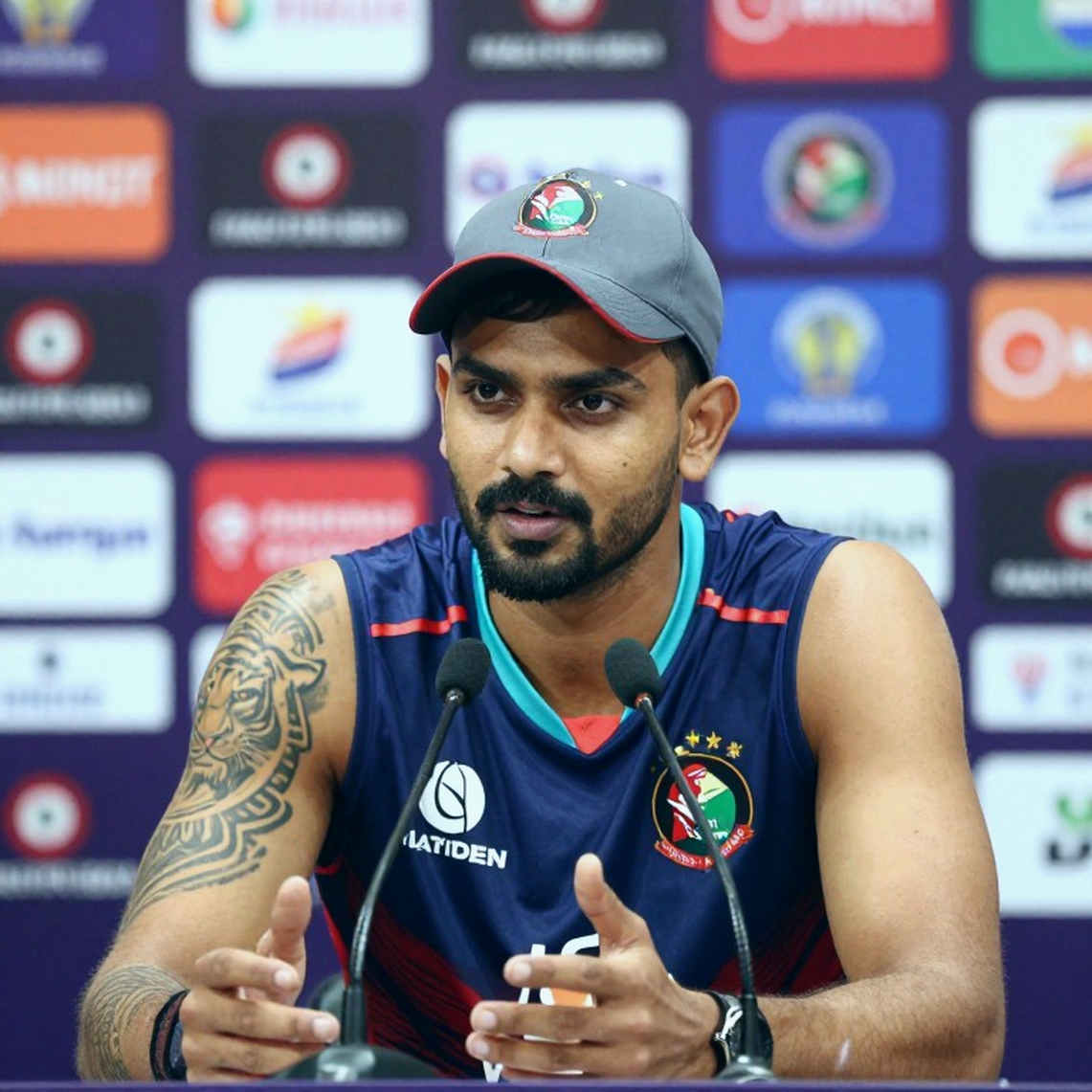
The way Bangladesh captain Najmul Hossain Shanto reacted to the defeat is a signal of leadership rather than of performance. He did not publicly blame his bowlers and credited West Indies for playing well. This is the standard captaincy playbook of protecting the dressing room in public and correcting things in private. It is credibility-positive for team management, but it reveals nothing about his own batting contribution — which is precisely the information the report omits.
Notably, Bangladesh's bowling failure is described collectively rather than through any individual. That suggests a unit-level problem rather than a single culprit, and it is a stronger indictment of the spin stocks and the selection than of any one bowler. Had a bowler taken five wickets in a losing cause, a report of this length would almost certainly have named him. The absence of a name is a weak but useful signal in itself.
Sammy gave credit for the win to the whole team, to its fight and to the preparations in Chennai. This is a coach's process message, and such messages tend to be most reliable when they follow an away win in unfamiliar conditions. It is one of the few claims in the report that is corroborable in principle, since camp logistics can be verified.
The significance of the Chennai camp is straightforward from a cricketing standpoint. The textbook method for acclimatising to subcontinental spin conditions is to prepare in a place where the pitches are similar in character. The sequence — camp in Chennai, then a win on a spin-friendly Mirpur track — is causally suggestive, although it cannot be proven from this report. As a cautious inference, it is fair to say West Indies prepared specifically for subcontinental conditions and that the preparation paid off in the first Test.
Then there is Sylhet, where the pitch has been described as a sporting wicket. That implies a surface offering a balance between bat and ball rather than one that disproportionately favours spin. If that is right, the hosts' spin advantage is diluted and the contest tightens. Sylhet is generally regarded as one of Bangladesh's better batting surfaces, with more carry for seam bowlers than Mirpur. If that assessment holds, the touring side's traditionally pace-based attack could benefit. This is general knowledge about the venue's character, not a verified pitch report for this match.
The phrase sporting wicket has not been attributed to any curator or board official. That suggests it reflects the touring camp's expectation rather than a verified pitch report. The one thing everyone should watch is the toss — and this report contains no mention of it. In a subcontinental Test, the toss is arguably the second-most important variable after the surface itself. Without it, comparing outcome with process becomes even harder.
The World Test Championship context makes this more than a bilateral series. The West Indies coach has explicitly referenced WTC goals, which means the match matters in terms of points as well. Both sides sit in the lower half of the ICC Test table rather than in the elite India, Australia and England bracket. That makes every point count, and it is why Sammy remains cautious even after a win.
The biggest question for Bangladesh is selection. If the bowling could not deliver even on a spin-friendly Mirpur pitch, going in with the same attack on a more balanced Sylhet surface would be a gamble. The options are limited but the direction is clear: either change the spin department and field a fresher pairing, or play an extra seamer and plan around the pitch's new character. Either way, pressure will shift onto the batting, because additional contributions will be demanded from the lower order.
West Indies' strategy, by contrast, looks clear and simple. A side leading the series does not need to take risks. It needs patience with the bat, big partnerships, and discipline with the ball. That is the most common formula for visiting teams succeeding in subcontinental conditions — lasting long and forcing the opposition into mistakes. The mention of the Chennai camp suggests work has been done along exactly those lines.
For Bangladesh head coach Phil Simmons, this match is a different kind of test. His tenure requires structural change in the team, and a home series is the safest arena to try such changes — provided results follow. If the bowling plan fails again in Sylhet, the question will not be about one match but about the team's long-term framework.
Historically, Bangladesh have been far stronger at home than away, with spin bowling on tailored pitches as the foundation of that strength. West Indies' record on tours of Asia, by contrast, has traditionally been poor. That is why the Mirpur win should be read not merely as the result of one match but as a reversal of a pattern. At the same time, drawing a series-wide conclusion from a single match would be premature.
Sylhet's surface could change the character of the cricket. If the pitch has bounce and pace, the role of the fast bowlers with the new ball grows and spinners must work patiently through long spells. If the surface is slow and abrasive, the contest could resemble the first Test, with the difference that the hosts will be under pressure this time. In either scenario the first session will be decisive, because it will establish what the pitch is actually doing — and only then can the sporting-wicket assumption be tested.
Batting responsibility will be more visible in this match. If Bangladesh are to save the series, they must post a substantial total, because in a low-scoring game the pressure always sits with the side batting behind. For captain Shanto this is personally important as well. This report contains no figures for him — no average, no recent form, no home-away splits. Any conclusion about his performance would therefore be speculation rather than analysis. What can be said is that the top order must spend time in the middle in Sylhet, because risk-heavy batting will not save a series.
The mental side matters no less. After losing the first Test, the hosts' biggest challenge is not technical but one of confidence. The captain has publicly defended his bowlers, sending a message that the problem is not individual; the task now is to convert that message into performance on the field. West Indies, meanwhile, have the luxury that comes with leading a series — they cannot lose it even without changing their game.
The crowd atmosphere in Sylhet will be a factor too. When home fans watch their team under pressure, both sympathy and expectation rise. If the hosts do not take the upper hand in the first few hours, the pressure can escalate quickly. That is exactly where Sammy's caution can be converted into a real tactical advantage.
Five things are worth watching in this match. First, the toss and the pitch's actual behaviour in the first session. Second, whether Bangladesh change their bowling structure. Third, how West Indies' batting handles the psychology of leading a series. Fourth, Shanto's own contribution and the top order's approach. Fifth, how WTC points shape both teams' priorities and the tempo of the game.
One point needs to be stated plainly: this report has been prepared without any player statistics, without a verified pitch report, without the toss, without a weather forecast and without session-by-session detail. The analysis here should therefore be read not as a firm prediction but as a map of likely directions based on the available information. What is certain is that West Indies lead 1-0, the final match of the series is in Sylhet, and the hosts have no route other than saving the series.
In a short two-Test series, the gap of one match becomes very large. What happened in Mirpur is a warning for Bangladesh and a lesson for West Indies — a reminder to both that home-pitch advantage is not received automatically, it must be earned. Sylhet will ask the same question again, this time in the opposite direction: can the touring side repeat the benefit of its preparation, and can the hosts correct their mistake? The answer will come in the match beginning on the 5th.
संबंधित खिलाड़ी
अनुशंसित
Santner's Warning: No Time to Breathe for New Zealand, Recovery Concerns Raised Ahead of First ODI2026-11-03
What ₹27 Crore Actually Bought: A Ledger Audit of the IPL 2026 Mega Auction2026-10-29
Chennai Pitch to Reveal New Asia Cup Formula: ACC Meeting to Finalize Schedule Blueprint, Will India-Pakistan Fixture Path Open?2026-11-03
Awana to Chair BCCI Junior Committee: A Red-Ball Panel, a White-Ball Calendar, and One Empty Chair2026-10-25
"Shocked": James Anderson Reveals Lancashire Ended the Conversation in Two Minutes2026-10-31
The Sooryavanshi Power Debate: The Question Buried Under the Noise2026-10-29
From the Asia Cup to Sharjah: The Part of Women's Cricket the Scorecard Never Records2026-11-02
अनुशंसित
The Ball Doesn't Age, the Story Does: Reporting a Ranji Morning the Scoreboard Never Printed2026-11-03
Harmanpreet Kaur's Eighth ODI Century: Three Dropped Catches, 328/6, and the Number Behind the Number2026-10-27
The Empty Rows: Where Cricket's Data Never Reaches, Decisions Still Get Made2026-10-30
Smith's Neck, Boland's Five Wickets and Cummins' Contrarian Call: Australia's Four-Change Gamble at Newlands2026-10-30
Five Million Dollars, Eight Franchises, and the Page Nobody Read2026-10-29
Namibia Beat Ireland 3-2: Ireland Bowled Out for 129 in Windhoek as Hosts Claim Historic Series2026-11-03
Four Out of Thirteen: The Purse and the NOC Are Asian Cricket's Real Selectors2026-11-02
अनुशंसित
Not the Twelve-Ball Fifty: Abhishek Sharma's Century, the Sidearm Ball and an Empty Scorecard2026-10-30
Empty Ledger, Full Format: Auditing a Report From the Asia Desk2026-10-28
Haris Rauf's Fifth Point: The Clock Ticking Underneath Lahore's One-Wicket Win2026-10-29
Auckland's 259: Phillips' Hundred Is the Headline, India's 16th Over Is the Story2026-10-30
One Practice Session in Mirpur, One Unasked Question in Sylhet: Where Bangladesh's WTC Equation Actually Stands2026-10-30
Past the Edge, Nobody at Slip: How India's Powerplay Wobbled in 6.5 Overs2026-10-26
'Information Voids' in Cricket Content Pipelines: The Reporting Crisis When the Data Is Empty2026-11-01
अनुशंसित
Seam for Sanju and Shreyas, Ease for Abhishek and Sooryavanshi: Why the Headline Weighed Two Innings on One Scale2026-10-29
Play stopped due to poor light, Bangladesh lead 1062026-10-31
From 112/6 to Victory: Tilak Varma and Nitish Kumar Reddy's Unbroken 69-Run Stand Seals India's Four-Wicket Win on the Last Ball2026-10-25
The Empty Column: Cricket's Most Dangerous Injury Number Is the One Nobody Ever Filled In2026-10-29
The Statistic That Lost Its Format: Empty Analysis and the Crisis Inside Cricket's Coverage Economy2026-11-02
Chasing 326 With Nine Balls Left: What Pakistan Won in Lahore, and What the Card Has Not Said Yet2026-11-02
Behind Shanto's 'small targets' sits Bangladesh's six-Test arithmetic2026-10-28