
Thuy Linh's Reign Over Vietnamese Women's Badminton: A Ninth Straight National Title, But the Succession Question Stays Unanswered
वियतनाम की शीर्ष महिला बैडमिंटन खिलाड़ी गुयेन थुई लिन्ह ने क्वांग त्रि में 20-25 अक्टूबर 2026 तक आयोजित राष्ट्रीय शीर्ष खिलाड़ी चैंपियनशिप में महिला सिंगल्स खिताब जीता — यह उनका लगातार नौवां राष्ट्रीय खिताब (2018-2026) है। 28 वर्षीय खिलाड़ी ने फाइनल में 34 वर्षीय वू थी ट्रांग को 21-11, 21-8 से हराया (स्रोत में दिए गए सेट स्कोर के अनुसार; मूल रिपोर्टिंग में इसे 2-1 की वापसी बताया गया है, जो इन स्कोरों से मेल नहीं खाता)। थुई लिन्ह की विश्व रैंकिंग लगभग 28वीं है और वे शीर्ष-8 सीडिंग बैंड से बाहर हैं; यह चैंपियनशिप घरेलू है और BWF रैंकिंग अंक नहीं देती। टूर्नामेंट में 14 प्रांतों से लगभग 150 खिलाड़ी और पांच स्पर्धाएं शामिल थीं। सबसे महत्वपूर्ण संकेत: 2025 और 2026 में वही दोनों वरिष्ठ खिलाड़ी फाइनल में पहुंचीं, जो वियतनामी महिला सिंगल्स में उत्तराधिकार-निर्वात (succession vacuum) और एकल-सितारा निर्भरता दर्शाता है। थुई लिन्ह तीन बार वियतनाम ओपन विजेता और टोक्यो 2020 व पेरिस 2024 ओलंपियन हैं।
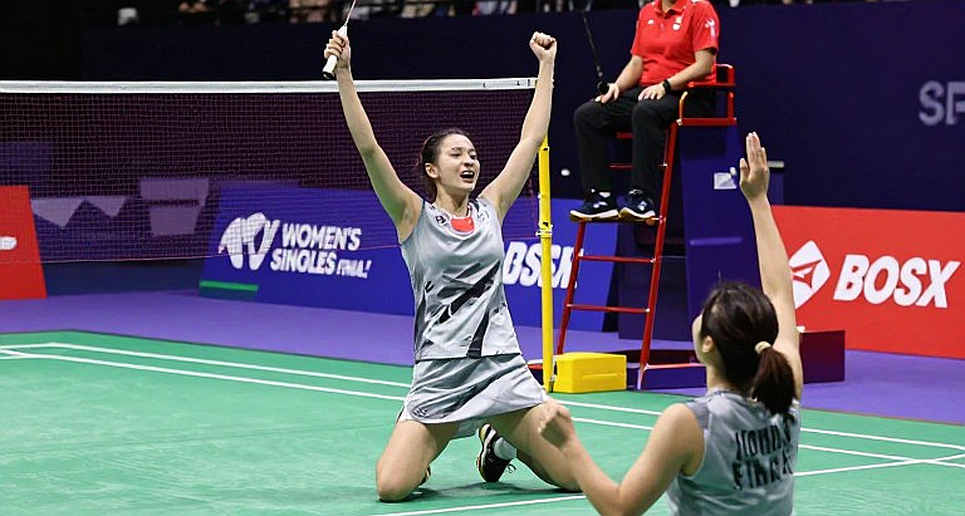
Vietnam's No. 1 women's singles player, Nguyễn Thùy Linh, won the women's singles title at the Vietnam National Top-Players Badminton Championship held in Quảng Trị province from 20 to 25 October 2026. The victory gave the 28-year-old a ninth consecutive national title, spanning the 2026 to 2026 editions — nine straight years in which no Vietnamese woman has been able to stop her.
In the final she defeated the veteran Vũ Thị Trang. The available scoreline reads 21-11, 21-8 — a straight-sets win. It was the same final pairing as in 2026. Two consecutive years in which the same two senior players contested the final points directly to a serious gap in Vietnam's women's singles succession pipeline.
The first and most important fact about this story is that Thùy Linh's domestic dominance is uncontested. What that dominance means at world level is a separate question — and that is the central subject of this report.
The Final: A One-Sided Contest
On paper this should have been a competitive final. Both players rank among Vietnam's best women's singles players of all time, both have long experience, and both met on the same stage a year earlier. What happened on court was one-sided.
In the first set Vũ Thị Trang offered early resistance and the score reached 6-6. That was the only moment the contest looked balanced. Thùy Linh then raised the tempo and moved to an 11-6 lead — a five-point burst immediately after 6-6. The first set closed at 21-11. The second set offered no resistance at all and ended 21-8.
Taken as a whole, the match was never close by any measure. Across two sets the opponent scored just 19 points. The meaning of such a scoreline is clear: the winner's level was plainly above the opponent's, and that gap came primarily from physical fitness and the ability to cover all four corners of the court.
A Material Data Discrepancy That Should Not Be Ignored
There is an unmistakable internal contradiction in the source reporting around this match. On one hand it is stated that Thùy Linh won the title by coming back from 2-1; on the other hand the reported set scores are 21-11 and 21-8 — which describe a 2-0 straight-sets win.
Both cannot be true. A 2-1 result means three sets were played and the winner lost the first; 21-11, 21-8 means two sets, both won by the same player, and no comeback at all. Detailed set scores are generally the more reliable element, because they are transcribed from the scoreboard, whereas words like 'comeback' are added during writing. This report therefore treats the detailed scoreline (21-11, 21-8) as the basis and treats the 2-1 claim as questionable.
This is not a trivial point. Anyone citing or building on this match data should first verify the score against an independent source. Discrepancies of this kind in sports journalism typically arise when the impulse to add drama to the writing overrides the data.
Playing Style: The Movement-Attrition Method
The picture that emerges from the account of the match is of a mature control player. The mechanism of Thùy Linh's win was movement attrition — she used shot variety (drops, clears, net play) to keep the opponent running, which drained the 34-year-old Vũ Thị Trang's stamina and induced errors.
This is a classic method of the control style and is highly effective against a slower opponent. It also has a clear limit: against a younger, faster, defensively strong world-class player, the same method neutralises. In other words, the weapon that works domestically will not automatically work inside the world top 20.
The most professional passage of the match was the phase in the first set when the score stood at 6-6 and the winner then moved to 11-6. That suggests a short probing phase followed by a gear change. It is a mature competitive habit: spend the first few points reading the opponent's rhythm and pace, then suddenly raise the intensity to open a gap. But one set of one match does not prove this is a stable pattern. It is an observation, not a conclusion.
It is also worth noting that the available reporting contains no smash-speed, average rally-length, error-rate or net-point data. Any claim of technical superiority is therefore unsupported by data — it rests only on the outcome against a weaker opponent. That is a significant methodological limit.
Nine Years of Reign: 2026 to 2026
Thùy Linh's nine consecutive national titles is a genuine achievement. The period 2026 to 2026 spans exactly nine editions, so there is no gap — arithmetically the claim is internally consistent.
Her career is also unusually long. Born on 20 November 2026, she has been competing at professional level since the age of 14, which means a professional career of roughly 14 years. In that time she has won the Vietnam Open three times and represented Vietnam at two Olympic Games — Tokyo 2026 and Paris 2026.
That is a complete and respectable career profile. But the same profile contains a curious contradiction: despite a 14-year international career and two Olympic appearances, her world ranking sits at approximately No. 28. That is a solid, respectable position — but below the elite tier.
A minor inconsistency on age has also been recorded. According to her birth date of 20 November 2026, she was 28 in October 2026, whereas one reference describes her as 29. This is likely loose drafting rather than a significant factual error, but it should be noted.
World Ranking No. 28: Domestic Summit, Global Mid-Tier
The BWF world ranking is based on a rolling 52-week system in which points accumulate from a player's best results. A No. 28 position is a solid achievement: it means the player is regularly reaching the later stages of international tournaments. It also means she sits outside the protected top-8 seeding band.
That matters competitively. At Super 1000 and Super 750 events, top-8 players receive protected draw positions. A player ranked around No. 28 gets no such protection, which means she can run into top seeds in the early rounds. In that situation, draw luck becomes a major variable in success.
Points defence is likewise a real factor, though no specific information is available and it therefore cannot be assessed.
The most important conclusion is that Thùy Linh occupies a 'domestic summit / global mid-tier' position. A nine-year domestic reign and a world ranking near No. 28 coexist, and the gap between them is wide. The source reporting does not reconcile that gap — it places the domestic title and the world ranking in the same sentence, which can create the impression that domestic dominance signals world-level readiness. It should not.
Vũ Thị Trang: Experience Against Fitness
Across the net in the final stood Vũ Thị Trang, an experienced and respected Vietnamese player. According to the available information, Thùy Linh's ranking is roughly 57 places above hers, implying Trang sits somewhere near No. 85.
That estimate is plausible, with a caveat: a veteran's historical stature and current ranking do not always tell the same story. Even so, at 34 she had to face a 28-year-old with world-level fitness, and the outcome indicates that this difference was decisive.
The 21-8 second set has been attributed primarily to the age and fitness gap. That is reasonable: when a player is repeatedly made to cover all four corners and is 34 years old, a decline in the second set is natural.
But this is also where an adverse-selection problem sits. When the ranking gap is 57 places, the match data mostly confirms expected dominance — it does not reveal new information. The competitive diagnostic value of this match is therefore low. It is better described as confirmation than as a test.
Tournament System: A Domestic Championship, No BWF Points
It is necessary to understand what tier this tournament occupied. The Vietnam National Top-Players Badminton Championship is a domestic national championship — it is not a BWF World Tour tier. The direct consequence is that this tournament awards no world-ranking points.
The second consequence is that results here cannot be used to infer world-level form. A national title and a lower-tier Vietnam Open title together do not indicate a breakthrough into the world top 20.
The size of the tournament does give a picture of the national structure. This edition drew roughly 150 athletes from 14 provinces and cities across five events. That indicates a functioning national competitive structure — it is not small.
But the same structure exposes a weakness. When the same two senior players reach the final two years in a row, it means the top layer is very thin. In format terms this is a single-elimination domestic championship over six days, where stronger players should generally prevail — randomness is low. Even so, both veterans reaching the final every year shows that the seeding and provincial structure reliably funnels the top two through, with no effective challenge beneath them.
This is a signal of stagnation in domestic competition. It is good for confidence and harmful for competitive sharpening ahead of international events.
The Succession Vacuum: The Most Important Signal in This Report
If one element of this story is analytically significant, it is this: two consecutive years of the same two senior finalists reveals a serious deficiency in Vietnam's women's singles succession pool.
This is a signal buried under a celebratory headline. The headline says 'Thùy Linh's dominance continues' — which is true domestically. The real story is that there is no answer to the question of who comes after her.
The direct structural meaning is that Vietnamese women's singles is a single-point-of-failure configuration. One world No. 28 carries the entire category, the runner-up is more than five years older, and no young contender has been named.
That is not a strong configuration; it is a fragile one. If Thùy Linh's form dips or she leaves the sport, Vietnam appears to have no other name capable of representing it in women's singles at world level.
The concern sharpens on the timeline. She is 28 and in her peak phase — a phase that typically lasts another two to four years. That means during the Los Angeles 2028 Olympic cycle she will either be at the very end of her peak or descending from it. If no successor is ready by then, the category will drop sharply.
Regional Comparison: Behind on Depth
Compare Vietnamese women's singles with its Southeast Asian peers and the picture becomes clear. Thailand, Indonesia and Malaysia have historically produced several world-class women's players at once — their depth is greater. Vietnam has one world No. 28 and a large gap beneath her.
This does not mean Vietnamese women's badminton is weak. It means its dominance is localised. One player's level is global; the category's collective strength sits below regional standards.
One subtle hypothesis is also worth noting: it is possible that Thùy Linh's long dominance is suppressing the visibility of younger players rather than developing them. When domestic media and resources concentrate on a single star, the next generation does not receive the competitive exposure that would develop it. This is a low-confidence hypothesis, but it cannot be dismissed.
Risk Matrix
At the level of this match and this player, risk is low — a comfortable win, no injury signals, no disciplinary issues. At the level of the category, risk is high.
Injury risk is medium. Age 28 on a 14-year career implies the accumulated effect of chronic load. This is not addressed in the reporting.
Competitive risk is medium. Domestic dominance can mask a world-level plateau. For an established player, remaining at No. 28 for an extended period is a signal that no leap has been made at global level.
Ranking and qualification risk is medium. A non-seeded ranking means hard draws at majors. The response should be to accumulate points at Super 500 and Super 750 events to enter the top-16 band.
But the largest risk is the succession vacuum, and it is rated high. Its probability is high because no positive indicator currently exists. Its impact is also high because it affects the entire category, not one player.
A further risk is competitive complacency. When the same final pairing appears in 2026 and 2026, the star is not undergoing any stress test domestically before international competition.
No rule or disciplinary risk surfaced in this reporting. Public-opinion and commercial risk is low — coverage is overwhelmingly positive.
Olympic Cycle and the Expectation Gap
Thùy Linh is a two-time Olympian — Tokyo 2026 and Paris 2026. The current phase is the digestion of Paris 2026 and the build toward Los Angeles 2028.
In this cycle she is naturally the flagship of Vietnamese women's singles. That role carries a burden: the 'hope of the category' rests on one player. The reporting does not describe this pressure, but it is a logical inference.
This is where an expectation-gap risk sits. Domestic fans may read the word 'dominance' as world-level readiness, whereas the ranking and result-quality data describe a mid-tier global position. That divergence could produce disappointment at major events.
Domestically the narrative is sustainable. As long as no young Vietnamese challenger emerges, the media's 'reign' framing will hold. Ironically, the absence of challengers is what keeps the narrative intact.
Coaching and Support System: Insufficient Information
Information on this dimension is essentially zero. Head coach, coaching-staff stability, sparring partners, technical analysis, strength and conditioning, rehabilitation support, technology adoption — none of these is documented.
Only one inference can be drawn indirectly: the ability to sustain shot variety and a fitness advantage into the second set at age 28 hints at adequate conditioning support. But that is weak, single-match evidence.
A long career since age 14 also implies that a functioning long-term development pathway existed in her environment. The reporting gives no detail on it.
Rules and Institutional Dimension: Neutral
The report raises no rule-level controversy. Serving, challenges, withdrawals — none is addressed. From a rules standpoint it is institutionally neutral and offers no evaluable governance signal.
BWF-level rules (ranking points, Olympic qualification, service height, mandatory participation) are not implicated by this domestic event, so no active controversy at that level can be assessed.
The only institutional inference available is that the domestic selection and development pipeline is currently not producing women's singles successors. That is a soft institutional-capacity concern, not a rule violation.
Industry and Commercial Transmission
The reporting contains no information on equipment brands, sponsorship, broadcast rights, prize money, betting or capital flows. Most of this dimension is therefore not assessable.
One structural signal does exist. Single-star dependency tends to concentrate domestic commercial and media attention on one athlete. Over the long term this can suppress visibility-driven development of a broader talent pool — a negative feedback loop for the talent chain.
On the positive side, a national championship with 14 provinces and 150 athletes indicates a live participation base. That base could support the coaching and club market, although the reporting does not confirm commercial activity.
Conclusion: The Title Is Real, and So Is the Concern
This title is entirely valid and reinforces Thùy Linh's domestic standing. Nine consecutive titles is a rare achievement with genuine meaning in domestic sporting culture.
But the real analytical value of this story is not in the headline; it is in what the headline concealed: the succession gap. That is a category-level structural risk, and it is larger than the celebratory framing.
The match data has low competitive diagnostic value because the ranking gap was large and the result was expected. The reporting also contains a material internal contradiction that must be verified before any reuse.
What to Watch Next
First: whether a Vietnamese woman under 23 reaches the national final or enters the world top 200. That would reduce the succession risk.
Second: the direction of Thùy Linh's world ranking. Movement toward the top 16 or a slide below roughly No. 35 over the next 12 to 24 months will say a great deal.
Third: the composition of the 2027 national final. A new name there would be an early indicator of pipeline recovery; the same pairing again would signal continued stagnation.
Fourth: her results specifically at Super 500 and above international events — not domestic titles. Real world standing will be settled there.
One final and explicit caveat: every fact drawn from the source reporting is presented here with its recorded limits. The score contradiction must be verified against an authoritative source before citation. Sports results are highly uncertain and this material is provided for sports-information reference only, not as betting advice of any kind.